
Rule of Law and Economic Development
Rule of law is critical to attracting foreign investment and the economic development of Cuba.
Part 2 of 3 Parts
What is Rule of Law?
Basically, rule of law is the principle that society should be governed by neutral universal rules: Legal detriments should be imposed by law and not on the basis of personal discretion; government action should be taken by rules that apply to all, including the rule-makers; and persons should be protected from private action that is coercive.[1]
While the practice of writing down the rules by which a society operates probably dates back in the European World to the 6th century BC., rule of law, as a legal principle developed throughout the centuries, and encompasses more than written rules. Its origins in the Anglo-American legal tradition dates back to the adoption of the Magna Carta in 1215[2]. That agreement first established the supremacy of the law, as the sovereign was recognized for the first time to be subject to the law. Furthermore, it contained the notion that all persons should be secure from the arbitrary exercise of power by the government.
In addition to the fundamental equitable principle that all persons and institutions, including the State, are accountable to each other under the law, rule of law has developed to specifically require that:
- The laws be publicly promulgated. This means that they are published by a method that makes them generally available to anyone and everyone so that it is reasonably possible for people to follow the law. Secret regulations and arrangements between the government and any other person are contrary to the rule of law. The law purports to set expectations for how persons should behave and those persons should be able to understand and follow the rules.
- The laws be equally enforced. Law must be reasonable – they must be more than an exercise of discretion – and they must be general, rather than targeted at specific persons. The term equal enforcement is often accompanied with the phrase “without fear of favor”. The tribunal enforcing the law cannot hesitate to act out of fear, or bestow a favor on a party because of its status or connections. The law must be applied uniformly regardless of the status or power of the parties before it.
- The tribunal enforcing the law be independent. In its decision-making, the tribunal cannot be subject to any form of coercion or punishment by others and must apply the law in its sole judgment. Independence means that it cannot take orders from other branches of government but use its best judgment in interpreting and applying the law.
- The laws be consistent with international human rights principles. These include the protection by the courts of individual property rights and the enforcement by the courts of contracts between parties, features that are of particular importance for economic development.
Order of Priority of Law
In addition to the adoption of laws, the order of priority of law must be clear to qualify as a rule of law system. For example, in 2019, Cuba adopted a new constitution (the “Constitution of 2019”), which included, among other provisions, the right of free association. Thereafter, in reaction to street protests, the National Assembly of People’s Power (the “National Assembly”) adopted a law that essentially prohibited free association.
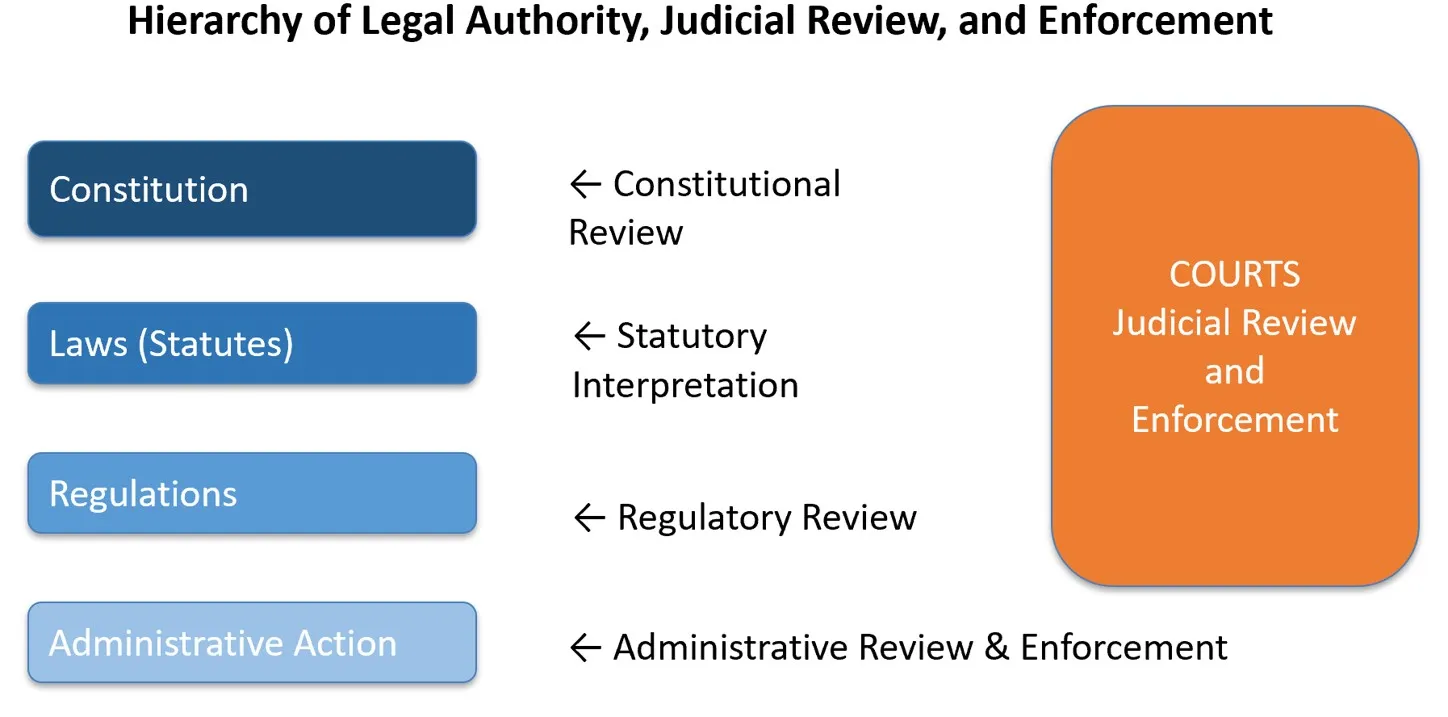
In a rule of law system, the constitution serves as the supreme law of the land and the laws that are adopted in the land can detail particular constitutional provisions but cannot contradict the constitution. Similarly, the regulations that are adopted under particular laws may interpret but cannot contradict the laws under which they are adopted. In a rule of law system, courts would find null and void laws that contradict constitutional provisions or regulations that contravene the laws under which they are adopted.
Clear Lines of Authority
The authority to regulate private economic activity under rule of law is divided between the central government and local governments, and the law specifies which ministry is responsible for regulating and overseeing each aspect of private-sector activity. Within ministries and other government agencies, the delegation of authority to divisions and offices needs to clearly empower action by the designated regulatory group and those decisions should not be overruled by superiors unless the regulatory decision is clearly at odds with the regulation with which it is complying.
Cuba has operated under a system where there are no clear lines of authority. Ministry action has been overruled by the Communist Party and the Party itself has been overruled by its original Revolutionary founders, even though they no longer hold governmental or Communist Party positions. It is not uncommon for the approval given by a specific office to be overruled by someone else who often remains unidentified.
In a rule of law system, Cuba would have to establish clear scope for the regulatory authority of the State and local governments, and those need to implement clear rules for the delegation of authority within particular governmental departments. Everyone needs to know that the decisions taken by a particular office were properly taken under the law.
In sum, oversight procedures in a rule of law system must be transparent so that economic actors can obtain the guidance they need from the State to plan their investments and operate with confidence that they are complying with the law.
Why is Rule of Law Important to Economic Development?
Law creates certainty. It provides a framework that not only establishes rules of behavior but also creates expectations, allowing economic actors to innovate, engage in commerce, plan for the future growth of their enterprises, all of which result in economic development.
Rule of law addresses what professors Cooter & Schäfer[3] described as the “double-trust” dilemma. In a commercial transaction, such an acquisition of assets or a commercial contract, where performance is going to occur over time, both sides fear that the other side will not perform. It is the independent court, not beholden to either side or to any other governmental entity, that provides assurance of a fair resolution in the case of a dispute and the fair enforcement of property rights and contracts. Parties do not need to “have connections” at the court[4] and the less powerful do not need to fear the more powerful before the court.
Another important aspect of independent courts is that they legitimate government action. If a court upholds a law, the citizens are assured of its legitimacy; if a court strikes down a law, the legislature knows it must either adopt a compliant law or abandon it altogether. In a rule of law system, maintaining the legitimacy of the law and the State in the eyes of the population is of primary importance for the continued functioning of the State.
Private Sector Growth in Cuba
Economic development is most likely to occur when there is widespread participation in the economy, not when power and resources are concentrated in a small elite[5]. With clear rules and a fair independent arbiter, the conditions exist for this widespread economic participation and growth. Economic actors can do business with each other without having prior family or social connections, and without “recommendations” made by government actors, thus greatly expanding the range of mutually beneficial economic interactions.
Upon adoption of a rule of law system, Cubans could associate freely to innovate and create products to meet the needs of the population. Contacts can be made through any available means and people can work together on endeavors of mutual interest even if they live on different parts of the island and have never met. The knowledge that everyone is subject to the same rules - and that courts will make sure of that – would empower Cubans, in what is already a generally entrepreneurial society, to innovate, and lead to substantial growth in the economy. The extraordinary development of Miami is testimony to this entrepreneurial spirit among people of Cuban origin.
Adopting a rule of law system would serve as a barrier to a “grab what you can get for yourself” result, such as what occurred in Russia with regard to its efforts at privatizing formerly publicly owned assets after it eliminated its socialist system. It would also address a common fear among some Cubans that the transition to a market economy will leave Cuba in a position like many Latin American capitalist countries, where economic participation is limited to relatively small and impregnable elite groups in society resulting in a few getting rich and most being shut out of success in the economy. While one can argue great inequality already exists in Cuba and that economic power exists in the military groups that control a substantial part of the Cuban economy, many Cubans consider this inconsistent with the ideals of the of the system and as a result of geopolitical issues and economic distortions. The concept of having independent courts that enforce rules without fear or favor creating an even playing field is attractive to Cubans as an extension of the principle of social equality that is ingrained in their psyche.
Foreign Direct Investment
Just as private citizens associating to undertake a joint business fear that the other side will not perform, the foreign investor is particularly cautious about placing substantial capital at risk in a jurisdiction where it could lose all of part of its investment and not achieve the revenue it projected from that investment.
To date, foreign companies have structured their commercial relationships in Cuba so as not to have to rely on Cuban law and courts. As discussed in “Part 1. What is and What is Not Foreign Direct Investment”, foreign investors have structured their activities so that they both participate in the production or distribution abroad of a particular good. Under those arrangements, the foreign partner first receives the revenue from the commercial transaction, reimburses itself first for any upfront costs and then shares the revenue with the Cuban partner pursuant to the terms of the agreement.
The key to those arrangements is that the foreign partner is always paid first, as it markets the product abroad, and does not need to fear a dispute with the Cuban partner. The foreign partner has the upper hand as it holds all of the revenue as security for the resolution of any dispute with the Cuban partner. It does not rely on Cuban law or on the Cuban courts to solve any dispute. Confinement of business ventures involving foreigners to ones that fit this narrow model means that many ventures that would be potentially beneficial to both a foreigners and Cubans never have a chance to move ahead.
Specifically, this model of commercial arrangement would not protect any foreign investor who wants to invest in Cuba for the sale of products in Cuba or the joint development and production of a biomedical device in Cuba. This type of investor, who, for example, wants to build a chain of retail facilities throughout Cuba to sell home repair materials, would need to rely on Cuban law and Cuban courts to protect what could be a substantial capital investment in real estate leases, building distribution facilities, retail stores and storing inventory.
The many potential foreign investors who will need to rely on Cuban law and Cuban courts will need modern commercial laws under which to operate and independent courts to help them resolve their disputes with their business partners. “Part 3. What Cuba Needs to do to Attract the Multinational Investor" discusses in greater detail what legal intuitional changes are necessary for Cuba to begin development of a rule of law system and attract foreign direct investment.
[1] See, Thomas Merrill, “The Essential Meaning of the Rule of Law”, 17 j. l., econ. & pol’y 673 (2022).
[2] In 1215, the long-running power struggle between king and nobles resulted in King John reaching an agreement with the English nobles. The agreement, enshrined as the Magna Carta, first established the concept that the King, and by extension the government, was also subject to the law. The primacy of law contained in the Magna Carta later influenced the Bill of Rights included in the Constitution of the United States and in the constitutions of many democratic states around the world.
[3] See, generally, Cooter, Robert D. & Schäfer, Hans-Bernd, Solomon’s Knot: How Law Can Solve the Poverty of Nations, Princeton University Press, 2012.
[4] Most rule of law legal systems require decision-makers to recuse themselves from considering matters that come before them when that is needed to eliminate actual or perceived bias.
[5] See, generally, Acemoglu, Daron and Robinson, James A., Why Nations Fail: The Origins of Power, Prosperity, and Poverty, Crown Publishers, 2012.