
Cuba: Macroeconomic Imbalances, the Crisis of Capital Accumulation, and the External Sector
Reversing this situation will require far-reaching structural reforms to Cuba’s productive system, business sector, regulatory framework, and incentive structure.
My dear friend Antonio Romero left this work unfinished. He had promised me this article for publication in Horizonte Cubano, but his passing prevented him from completing it. In his honor, I decided to put the finishing touches on it and publish it as a tribute to his extraordinary talent as an economist.

The Cuban economy has been mired in a profound structural crisis for several years, and the principal indicators associated with the country's external sector have deteriorated sharply.
All indications suggest that, in today's highly uncertain international environment, the negative trends inherent in Cuba's unsustainable pattern of external economic relations are likely to intensify.
Several Cuban economists have consistently argued that without a coherent, effective, and determined macroeconomic stabilization program—and without profound structural reforms—it will be impossible to alter Cuba's pattern of external economic integration.
Discussions of macroeconomic stabilization have generally emphasized internal balances, particularly the fiscal deficit and inflation. However, stabilization programs must also address the balance of payments, especially in economies such as Cuba's. Consequently, one of the fundamental objectives of stabilization in the Cuban economy should be restoring equilibrium to the country's external accounts.
At the same time, any effort to confront the economic decline and the deterioration of Cuba's external sector over recent years must incorporate the concept of deep structural transformation.
This article presents, in summary form, several ideas intended to link the crises in the country's economic and external sectors, the need for macroeconomic stabilization, structural reform, and changes in Cuba's pattern of international economic engagement.
Economic Activity and External Sector Indicators
In recent years, Cuba's economy has followed a regressive path characterized by mounting distortions at both the macroeconomic and microeconomic levels. This negative trajectory has manifested itself in stagnant economic growth over the past decade, including four consecutive years of economic recession between 2019 and 2024.
At the same time, fiscal deficits have reached unsustainable levels, with public-sector deficits remaining in the double digits as a percentage of GDP since 2020.
As a result of this destructive combination of factors—and others as well—the Consumer Price Index (CPI) has risen sharply since 2020, producing dramatic effects on the incomes and consumption levels of most of the population while severely eroding the purchasing power of the national currency.
In short, Cuba has experienced more than five years of stagflation, with all the social, political, and institutional consequences that such an economic environment inevitably entails.
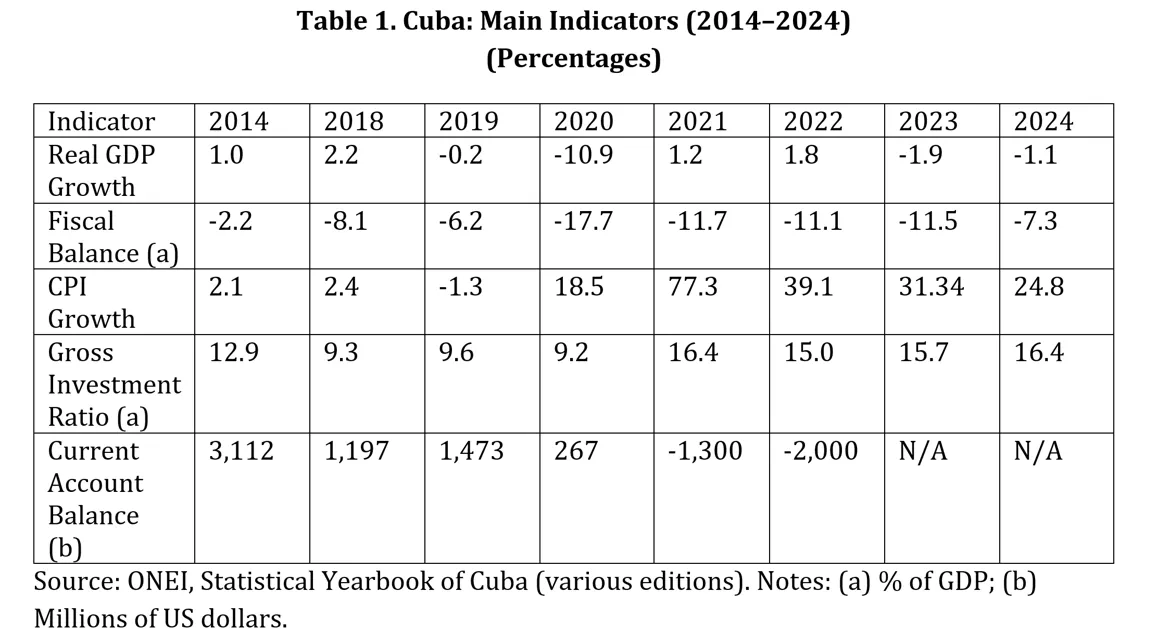
A key indicator that largely explains the country's long-term economic stagnation, aggravated in recent years, is gross investment as a share of total output. Between 2014 and 2023, gross investment averaged only 10.9 percent of GDP.
This level of investment has not even been sufficient to ensure simple capital replacement. For many years, the performance of the Cuban economy has failed even to replace the capital consumed or depreciated in the production process.
As a consequence, the country lacks the capacity both to expand its productive potential and to prevent the progressive decapitalization of its physical and productive infrastructure.
This is perhaps the clearest manifestation of what the economic literature describes as an "accumulation crisis." It should be understood as the fundamental nature of Cuba's current economic crisis and as an essential concept for understanding the depth of the structural changes required for the country to overcome its present predicament.
Ultimately, accumulation crises can only be overcome by transforming the pattern of accumulation, understood in its broadest sense as fundamental changes in the relationship between the productive forces and the system of social relations of production.
The ongoing decapitalization of the nation's productive infrastructure—and indeed its infrastructure more generally—lies at the root of the sharp deterioration in production, productivity, and competitiveness. It therefore provides the principal explanation for the severe external constraints that have repeatedly afflicted the Cuban economy.
It is also important to emphasize that Cuba's exceptionally low level of gross fixed capital formation over the past two decades has been accompanied by another distinctive feature: the country's limited investment has been excessively concentrated in tourism-related infrastructure and real estate, while agriculture, manufacturing, and innovation have received only minimal investment resources.
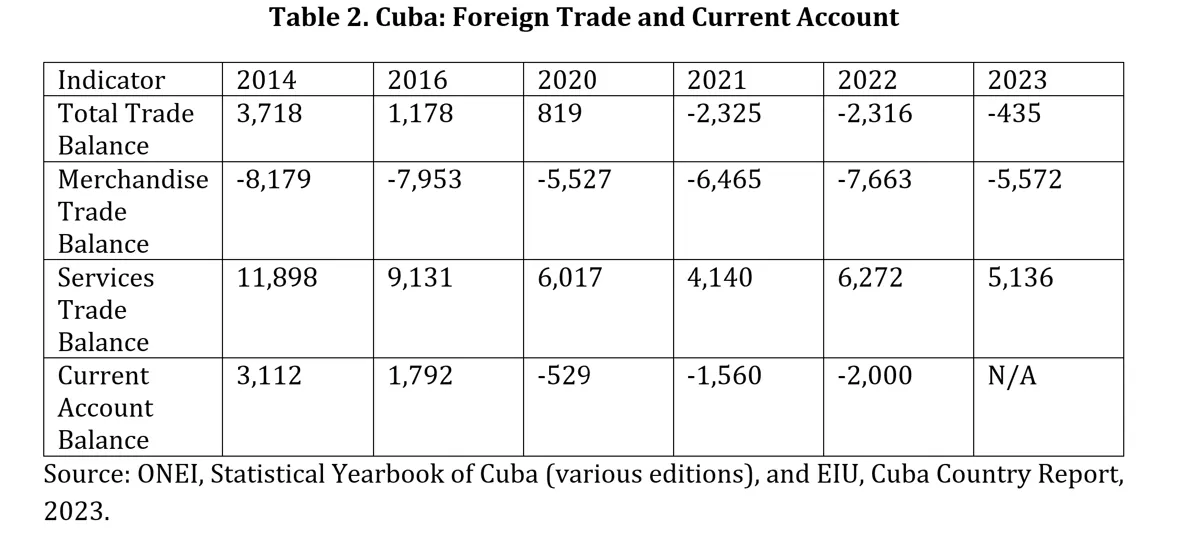
The accumulation crisis that has gripped the Cuban economy for many years—and that defines its domestic structural conditions—has played a decisive role in shaping, developing, and consolidating Cuba's pattern of external economic integration. To a large extent, it explains the characteristics that have defined Cuba's external economic relations for years and that have now become even more pronounced, in particular:
- A very limited capacity to replace imports with domestic production and to transform domestic production into exportable goods.
- An exceptionally high voracity for imports.
- An inability to capitalize on preferential access to major foreign markets secured through existing trade and cooperation agreements. I
- A marked loss of participation in world trade, together with the failure to diversify the country's export structure in recent years.
- Recurring episodes of severe external financial liquidity crises, despite successful debt renegotiation processes that resulted in the cancellation of substantial portions of the country's accumulated external financial obligations.
Reversing the pattern described above requires radical structural transformations that reshape the country's productive structure, business organization and enterprise system, resource allocation mechanisms, system of incentives, income distribution, and the fundamental rules governing the economy.
Many of these necessary reforms were already incorporated into the Economic and Social Policy Guidelines approved—and subsequently updated—at the last three Congresses of the Communist Party. However, implementation has consistently fallen far short of expectations, preventing the country from overcoming stagnation, correcting distortions, improving efficiency, and reducing external vulnerabilities.
Short-Term Policy Proposals
There are several policy measures and decisions that could be implemented in the very near term. They would help alleviate some of the bottlenecks currently preventing a short-term improvement in the country's external economic position. Among the most important are the following:
Redefine investment priorities to support productive development. This would create conditions to increase, in the short and medium term, the substitution of imports—particularly food products—and, over the medium and long term, to expand exports. Doing so would require redirecting public investment currently devoted in disproportionately large measure to the tourism sector toward agriculture, manufacturing, and, above all, energy infrastructure.
Relax existing regulations and procedures that, in practice, discourage exports and import substitution by both state-owned enterprises and non-state forms of management (by its acronym in Spanish “FGNE”). This would require granting greater autonomy to state-owned enterprises as part of a comprehensive reform of the enterprise system, while further reducing bureaucratic procedures, permitting requirements, and the associated logistical and regulatory costs affecting export and import-substitution projects undertaken by both the non-state sector and state enterprises.
Consider implementing a range of policy instruments widely used in developing countries not only to promote exports but also to facilitate the many processes associated with international trade.
The Single Window for Foreign Trade (VUCE) and the Single Window for Foreign Investment (VUIEX) are long-established instruments used throughout the world. In Cuba, however, they remain far from meeting accepted standards of integration, interoperability, and the automatic issuance of licenses, certifications, and authorizations. They continue to suffer from significant shortcomings in three areas: (a) the technical architecture of the system; (b) its information technology architecture; and (c) the governance framework under which these mechanisms operate.
Radically and promptly revise the current exchange-rate policy. This should entail transforming the structure and operation of the foreign exchange market, the exchange rate itself, and the exchange-rate regime. Without such reforms, it is highly unlikely that exports or efficient import substitution will receive the incentives they require.
These reforms should be viewed as integral components of macroeconomic stabilization and structural reform. In turn, they would contribute to the necessary process of de-dollarization, without which it will be extremely difficult to restore the minimum level of confidence in national economic policy that is essential for both stabilization and renewed economic growth.
Approve and implement the long-delayed legal framework that would transparently permit non-state enterprises (FGNEs) to establish businesses with foreign capital. At the same time, the regulatory framework and current policies governing foreign investment should be reassessed. Restrictive provisions remain in force that fail to recognize the high level of risk assumed by foreign investors who choose to do business in Cuba.
Encourage remittance flows to Cubans residing on the island, based on flexible rules and full respect for the fundamentally private nature of those transfers, particularly remittances that could be linked, directly or indirectly, to the development of productive enterprises. Achieving this objective requires approval of the legal framework governing foreign-capital partnerships involving non-state enterprises.
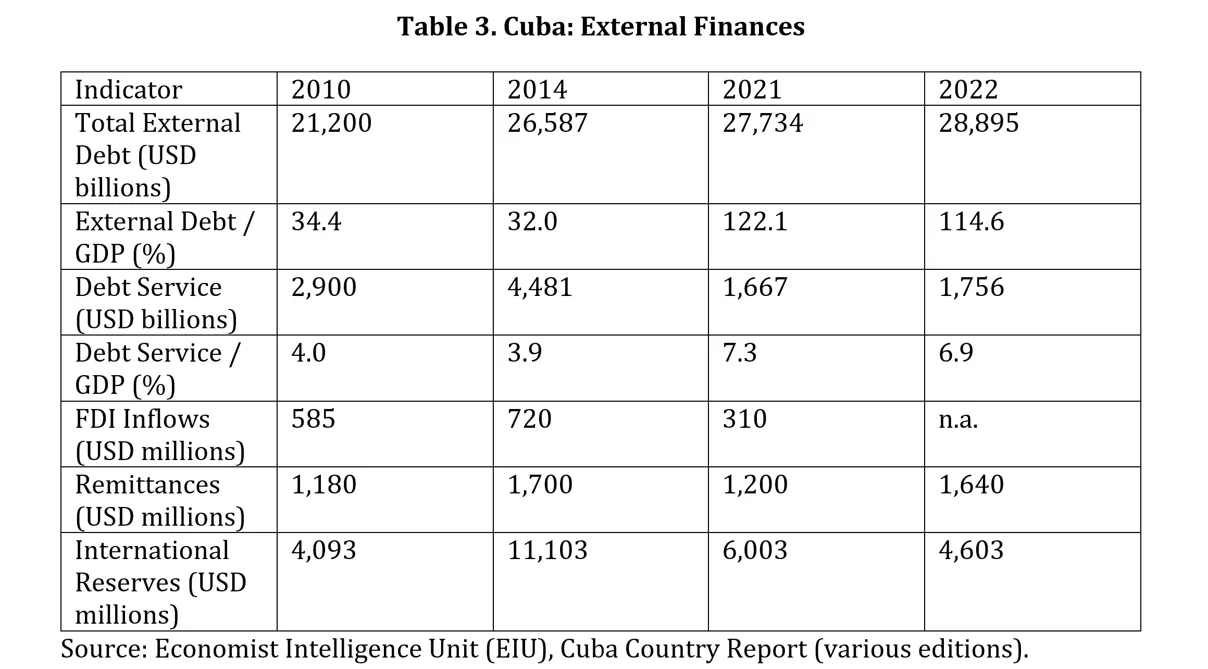
Develop a comprehensive strategy to renegotiate Cuba's accumulated external financial obligations. The country has once again entered into default. This strategy should encompass all components included within the concept of "external debt," namely:
a. obligations to official creditors, including the Paris Club, with which Cuba reached a highly favorable restructuring agreement in 2015 that included the cancellation of 90 percent of the outstanding debt;
b. obligations to private creditors, commonly referred to as the London Club;
c. short-term debt owed to suppliers; and
d. particularly important in Cuba's case, obligations owed to foreign investors.
Because settling the latter is essential to attracting larger inflows of foreign direct investment, Cuba should adopt a negotiated financial mechanism based on a menu of options for honoring its accumulated obligations to foreign investors. Naturally, the credibility required to conduct a serious and complex negotiation with creditors depends on the Cuban authorities demonstrating tangible progress in both macroeconomic stabilization and structural reform.
Without such progress—that is, without a credible and broadly accepted roadmap for radical changes to the country's economic structure—the current vicious cycle will simply repeat itself. At best, Cuba may obtain another round of debt restructuring accompanied by partial debt forgiveness. Within a few years, however, the country is likely to face yet another external liquidity crisis and another round of defaults on its negotiated obligations.
Conclusions
The Cuban economy is experiencing a profound structural crisis characterized by economic stagnation, prolonged recession, persistently high fiscal deficits, and sustained inflation. More than five years of stagflation have significantly eroded the population's standard of living.
At the heart of this crisis lies an accumulation crisis. Cuba invests far too little—gross investment has averaged only 10.9 percent of GDP—a level insufficient even to maintain the country's productive infrastructure. As a result, the economy has undergone a prolonged process of decapitalization and a corresponding loss of productive capacity.
This internal weakness has, in turn, produced an unsustainable pattern of external economic relations, characterized by a high dependence on imports, limited export capacity, the loss of foreign markets, and recurring crises of external liquidity.
Official economic policies and policy guidelines have proven insufficient and have been implemented only partially. The high degree of noncompliance has prevented the country from correcting structural distortions and advancing the reforms needed to restore growth.
External debt has risen to critical levels, and Cuba has once again fallen into default. Without deep structural reforms, the country will continue to cycle through repeated episodes of debt renegotiation followed by renewed default.
Reversing this situation requires radical structural transformations affecting the productive system, the enterprise sector, the regulatory framework, and the country's system of economic incentives.
Redirecting investment toward productive sectors, relaxing regulations governing exports, modernizing the single-window systems for trade and investment, reforming exchange-rate policy, permitting foreign capital to participate in non-state enterprises, facilitating productive remittances, and renegotiating the external debt through a comprehensive strategy are urgent measures that can no longer be postponed.

Cuban economist Antonio Romero Gómez (1961–2025), known among his colleagues and friends as Tony Romero, passed away in Havana on November 22.
Among his published works are numerous studies and research projects on international economics; international economic relations, with particular emphasis on international trade, integration, and cooperation in Latin America and the Caribbean; Cuba's integration into an increasingly globalized world, and the transformation of the Cuban economic and social model.
At Horizonte Cubano, we had the privilege of having him as a contributor and of benefiting from both his enthusiasm and his critical insight. For that reason, we are now publishing a paper that we had commissioned from him but that remained unfinished because of his untimely death. It has been completed thanks to the efforts of our editorial team.
May this publication stand as a modest but heartfelt tribute to Tony, one of the most distinguished Cuban economists of his generation.