
Cuban Migration to Brazil in the 21st Century
The flow of Cubans to Brazil has become one of the most dynamic chapters in the history of migration in Latin America. Partial data from January to June 2026 show the continuation of this flow, with 20,372 asylum applications recorded—59.31% of a total 34,346 so far this year.

Introduction
The dynamics of contemporary international human mobility have profoundly reshaped migratory corridors within the Global South, positioning Brazil as one of the primary destination and transit hubs in Latin America. Far from being a recent or isolated phenomenon, in fact, the welcoming and integration of international populations constitutes a structural cornerstone of Brazil’s demographic formation, socio-economic development, and protection of territorial sovereignty.
Among the diverse migratory currents directed toward Brazilian territory, the influx of citizens from the Republic of Cuba stands out for its political, legal, and professional singularities, as reflected in a statistically unprecedented surge in recent years. To accurately evaluate this phenomenon, it is essential to consider aspects such as Brazil’s historical tradition of granting asylum, the evolution of the migratory flows to Brazil, and the Brazilian constitutional legal architecture that transitioned from cold-war state security doctrines to the current focus on comprehensive reception, protection, and labor integration of immigrants, as part of the commitment to the protection of human rights.
Historical Formation and Classical Migratory Currents: 19th and 20th Centuries
The foundational premise of Brazil as a welcoming nation finds empirical support in its long-term demographic and legislative history. The formal abolition of the transatlantic slave trade in 1850, and the subsequent abolition of slavery in Brazil in 1888 forced a structural reconfiguration of the domestic formal labor market. The Imperial State and, subsequently, the First Republic implemented state-subsidized policies to actively attract European immigration, permanently altering the country's socio-cultural and agrarian profile.
Historical data aggregated by the Brazilian Institute of Geography and Statistics show that between 1820 and 1930, approximately 4.6 million immigrants entered the national territory. This macro-flow was structured around four major human migratory currents. The Italian current was the most statistically significant during the peak of the coffee economy. Between 1870 and 1920, an estimated 1.4 million Italians arrived, concentrating primarily in the state of São Paulo and the Southern region. The Portuguese current, facilitated by linguistic and cultural proximity, maintained a constant, highly urbanized flow, totaling 1.2 million immigrants to Brazil between 1820 and 1930. The Spanish immigration contributed approximately 590,000 individuals, who established strong networks in commercial and transportation sectors. The Germanic influx, initiated in 1824 with the founding of São Leopoldo, Rio Grande do Sul, although statistically smaller than the Italian, aggregated approximately 250,000 immigrants by the mid-20th century, and was critical to the demographic consolidation of the South through small-scale, polycultural family farming. Beginning in 1908, the Japanese immigration to Brazil began with the arrival of the cargo and passenger ship Kasato Maru in Santos. This immigrant group grew to approximately 250,000 prior to World War II and revolutionized domestic agricultural techniques. Today, Brazil hosts the largest population of Japanese descendants outside of Japan.
Following a period of relative border closure driven by President Getúlio Vargas’s nationalist policies, Brazil reconfigured its asylum traditions in the post-WWII era. The State shifted away from a purely utilitarian view of immigration for attracting agricultural labor toward a framework aligned with international human rights treaties. First, this was reflected in the absorption of European displaced persons in the late 1940s, followed by the welcoming of political dissidents fleeing military dictatorships in the Southern Cone during the 1970s and 1980s, which laid the institutional groundwork for modern Brazilian humanitarian diplomacy.
Humanitarian Passageways and South-South Flows: the 21st Century
In the contemporary era, Brazil’s humanitarian immigration framework has faced complex, transnational crises within the Global South. The State has responded by creating institutionalized pathways to accelerate documentation, solidifying the human rights-oriented profile of its migratory policies. Following the catastrophic 2010 earthquake in Port-au-Prince and influenced by Brazil's prominent military and diplomatic role in the United Nations mission thereafter, tens of thousands of Haitians sought entry into Brazil. Confronted with the legislative vacuum created by the rigid military-era of laws regarding immigration, the National Immigration Council issued humanitarian visas, allowing legal and safe entry to the Haitian immigrants. From 2011 to 2020, over 100,000 Haitians regularized their status, integrating principally into the industrial and construction sectors of the South and Southeast.
The largest logistical and humanitarian challenge in modern Brazilian history occurred along the northern border with Venezuela. According to data from the R4V Platform and the Ministry of Justice, from 2017 to 2024, over 500,000 Venezuelans requested asylum or temporary residency. The state's response crystallized in “Operation Welcome”, an inter-agency task force led by the Brazilian Armed Forces in partnership the federal government and civil society. This initiative successfully managed the voluntary internal resettlement of over 100,000 Venezuelans from the border state of Roraima to more than 900 municipalities nationwide, mitigating the strain on local public service services and fostering labor market integration.
The Cuban Migratory Flow: From Cooperative Frameworks to the Asylum Influx
An isolated analysis of Cuban migration to Brazil reveals two distinct phases: a first period defined by formal bilateral state agreements for professional and technical cooperation, and a contemporary period characterized by a severe multidimensional crisis in Cuba, leading to an exponential increase in international protection requests.
The initial group of Cubans arriving in recent decades was tied to the “More Doctors Healthcare Program” established in 2013. Managed through a triangular cooperation agreement with the Pan American Health Organization (PAHO), Brazil received more than 8,000 Cuban healthcare professionals. The unilateral termination of the agreement by Cuba in late 2018 triggered the phenomenon of "permanence migration". Data from the Observatory of International Migration (OBMigra), indicates that thousands of Cuban doctors chose not to return, filing for asylum or alternative migratory regularization to avoid administrative and political sanctions from the Cuban Government. This early Cuban cohort was characterized by exceptionally high human capital, technical expertise, and academic credentials.
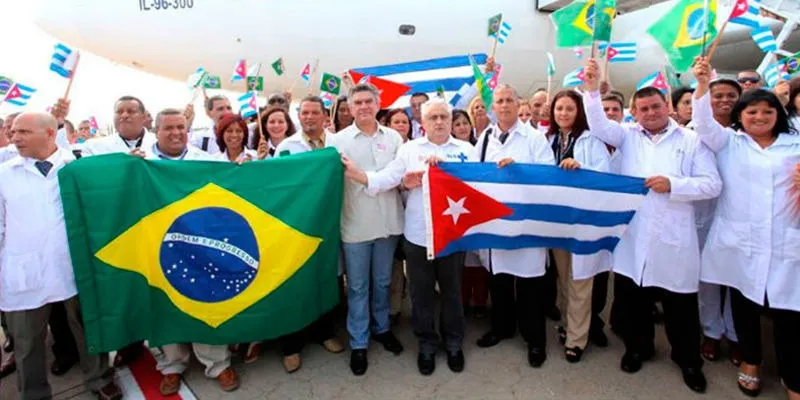
Following structural shifts in regional geopolitics and the worsening of the internal situation in Cuba, marked by severe energy grid collapses, hyperinflation, and acute scarcities, the profile of Cuban migration to Brazil underwent a radical transformation. According to the official “Refugee Status in Numbers Annual Report”, compiled by OBMigra and the Ministry of Justice and Public Security, the statistical landscape of international protection requests underwent a profound realignment. Following nearly a decade of Venezuelan dominance at the top of asylum charts, Cuban citizens became the leading nationality requesting asylum in Brazil. Annual asylum applications filed by Cuban nationals jumped from 22,288 requests, in 2024, to 41,919 requests, in 2025, representing a remarkable 88.1% year-over-year increase. Out of a total of 75,599 asylum requests received by the Brazilian state, in 2025, Cuban nationals accounted for 55.4% of all applications (41,919 requests), placing Venezuela in second place with 28.1% (21,233) asylum requests received. Partial data from January to June 2026 show the continuation of the migratory flow, registering 20,372 Cuban citizens requesting asylum, representing 59.31% of the total 34,346 of application for asylum. By contrast, in the period from January 2015 to June 2026, the total number of Cuban asylum applications was 114,779.
Institutional Reception, Territorial Distribution, and Labor Market Integration
Unlike historical flows managed through a security-centered lens, the modern reception of Cuban immigrants in Brazil is focused on their immediate documentation and qualification for receipt of public services. Upon filing an asylum claim, applicants are granted a provisional foreigner identification card, a taxpayer registration number (CPF), and immediate authorization to work. This policy prevents initial institutional marginalization, granting the Cuban population equal access to the Universal Healthcare System (SUS) and municipal social safety nets.
Although the initial entry points are heavily concentrated in northern border states, the Cuban population demonstrates a high index of secondary internal migration and autonomous interiorization. Driven by the search for robust economic opportunities, the Cuban diaspora has progressively relocated away from northern border regions toward the Southeast and Southern economic corridors. Municipal registries show significant hubs forming in metropolitan areas such as São Paulo, Campinas, Curitiba, and Porto Alegre, as well as medium-sized agro-industrial cities in the state of Santa Catarina. This territorial distribution is heavily accelerated by the pre-existing migrant networks and the decentralized nature of the Brazilian labor market.
The integration of Cuban nationals into the Brazilian formal economy presents a profound structural paradox for Brazil. Historically, Cuban immigrants possess an exceptionally high index of human capital, with over 60% holding university degrees or advanced technical certifications, heavily concentrated in medicine, engineering, and education. However, macro-data from the General Registry of Employed and Unemployed Persons (CAGED) reveals that the vast majority of this highly skilled workforce is absorbed by low-skilled formal employment. Cubans are predominantly employed in the service sector, retail commerce, industrial logistics, and basic hospitality services. This mismatch highlights a severe process of professional de-qualification.
The structural barrier perpetuating this phenomenon is the rigidity, protectionism, and high financial costs associated with the domestic revalidation of foreign academic titles. The National Exam for the Revalidation of Foreign Medical Degrees and equivalent boards for technical careers feature lengthy bureaucratic delays, forcing thousands of highly qualified individuals into underemployment or the informal economy to guarantee immediate economic survival.
Constitutional Legal Architecture and Legislative Evolution
The legal processing of this influx occurs within a highly progressive domestic statutory framework, characterized by the absolute rejection of the Cold War-era National Security Doctrine in favor of a human rights-centered paradigm. For nearly forty years, immigration was governed by Law No. 6.815/1980, Foreign Nationals Act, a statute enacted during the military regime that treated the migrant primarily as a potential threat to state sovereignty and public order. The enactment of the new Migration Law, Law No. 13.445/2017, represented a paradigm shift, establishing core statutory principles such as the unconditional rejection of xenophobia, universal access to public healthcare (SUS), and the absolute de-criminalization of irregular migration. For the Cuban community, this protective statutory environment guarantees that irregular entry via land borders does not lead to summary deportation or administrative detention, ensuring a due process right to apply for legal regular status.
The National Committee for Refugees, CONARE, an inter-ministerial collective body led by the Ministry of Justice, administers Law No. 9.474/1997, which incorporated the 1951 Refugee Convention into domestic law. Crucially, while Brazilian law incorporates the broader definition of refugee status found in the 1984 Cartagena Declaration, CONARE applies this standard through differing procedural mechanisms depending on the nationality of the refugee. While Venezuelan claims are processed through expedited, prima facie group recognition procedures, Cuban applicants face strict, individualized adjudication. CONARE reviews Cuban applications primarily under the traditional criteria of a "well-founded fear of persecution based on political opinion". Nevertheless, while a final adjudication is pending, the legal status of Cuban applicants is fully protected, shielding them from deportation and allowing uninterrupted access to employment and social welfare.
Conclusion
The contemporary Cuban influx into Brazil has emerged as one of the most dynamic chapters in Latin American migratory history. The sharp statistical pivot that positioned Cuban nationals as the leading group seeking international protection in Brazil demonstrates how complex political and macroeconomic crises rapidly reshape regional migratory corridors.
From a legal and policy perspective, Brazil has demonstrated institutional resilience by processing this significant surge without resorting to border closures, militarization, or the rollback of civil liberties. However, the current volume and demographic vulnerability of the arrivals require a transition from emergency border processing to long-term integration strategies. For Brazil, addressing the bureaucratic bottlenecks of professional degree revalidation represents not only a human rights imperative but a strategic opportunity to harness high-skill human capital for national development.
Bibliography
BAENINGER, R. et al. (Eds.). (2018). Migrações Sul-Sul [South-South Migrations] (2nd ed.). Nepo/Unicamp. [https://www.nepo.unicamp.br/publicacoes/livros/migracoes_ sul_ sul/migracoes_sul_sul.pdf].
BRAZIL. (1980). Lei nº 6.815, de 19 de agosto de 1980 [Foreigner Statute Law No. 6,815 of August 19, 1980; Revoked by Law No. 13,445/2017]. Diário Oficial da União. [https://www.planalto.gov.br/ccivil_03/leis/l6815.htm].
BRAZIL. (1997). Lei nº 9.474, de 22 de julho de 1997 [Refugee Statute Law No. 9,474 of July 22, 1997]. Diário Oficial da União. [https://www.planalto.gov.br/ccivil_03/leis/l9474.htm].
BRAZIL. (2017a). Decreto nº 9.199, de 20 de novembro de 2017 [Decree No. 9,199 of November 20, 2017, Regulating the Migration Law]. Diário Oficial da União. [https://www.planalto.gov.br/ccivil_03/_ato2015-2018/2017/decreto/d9199.htm].
BRAZIL. (2017b). Lei nº 13.445, de 24 de maio de 2017 [Migration Law No. 13,445 of May 24, 2017]. Diário Oficial da União. [https://www.planalto.gov.br/ccivil_03/_ato2015-2018/2017/lei/l13445.htm].
BRAZIL. Ministry of Development and Social Assistance, Family and Fight Against Hunger [MDS]. (n.d.). Coleção de notícias: Operação Acolhida [News Collection: Operation Welcome]. Portal MDS, Federal Government of Brazil. [www.gov.br].
BRAZIL. Relatórios Mensais 2026 [Monthly Reports 2026]. Observatory of International Migration [OBMigra]; Ministry of Justice and Public Security. [https://www.gov.br/mj/pt-br/assuntos/seus-direitos/migracoes/portal-de-imigracao-laboral/obmigra-1/relatorios-obmigra/relatorios-mensais/2026/2026].
CAVALCANTI, L., OLIVEIRA, A. T., & TONHATI T. (Eds.). (2014). A imigração haitiana no Brasil: características demográficas e socioeconômicas [Haitian Immigration to Brazil: Demographic and Socioeconomic Characteristics]. Observatory of International Migration [OBMigra]; Ministry of Labor and Employment. [https://www.gov.br/mj/pt-br/assuntos/seus-direitos/migracoes/portal-de-imigracao-laboral/obmigra-1/publicacoes/a-imigracao-haitiana-no-brasil.pdf/view].
CAVALCANTI, L., OLIVEIRA, T., & SILVA, B. G. (2021). Relatório Anual 2021 – 2011-2020: Uma década de desafios para a imigração e o refúgio no Brasil [Annual Report 2021 – 2011-2020: A Decade of Challenges for Immigration and Asylum in Brazil]. Migration Series. Observatory of International Migration [OBMigra]; Ministry of Justice and Public Security. [https://www.gov.br/mj/pt-br/assuntos/seus-direitos/migracoes/portal-de-imigracao-laboral/obmigra-1/relatorios-obmigra/relatorios-anuais/2021/relatorio_anual_-_completo-2021.pdf].
CAVALCANTI, L., OLIVEIRA, T., & SILVA, S. L. (2024). Relatório Anual OBMigra 2024 [OBMigra Annual Report 2024]. Migration Series. Observatory of International Migration [OBMigra]; Ministry of Justice and Public Security. [https://www.gov.br/mj/pt-br/assuntos/seus-direitos/migracoes/portal-de-imigracao-laboral/obmigra-1/relatorios-obmigra/relatorios-anuais/2024/relatorio_anual_2024.pdf].
CAVALCANTI, L., & OLIVEIRA, T. (2026). Dados Consolidados da Imigração no Brasil 2025 [Consolidated Data on Immigration in Brazil 2025]. Migration Series. Observatory of International Migration [OBMigra]; Ministry of Justice and Public Security.[https://www.gov.br/mj/pt-br/assuntos/seus-direitos/migracoes/portal-deimigra cao - laboral/obmigra-1/relatorios-obmigra/dados consolidados/2025/Dados2025.pdf].
CLARO, C. A. B. (2020). Do Estatuto do Estrangeiro à Lei de Migração: avanços e expectativas [From the Foreigner Statute to the Migration Law: Advances and Expectations]. Boletim de Economia e Política Internacional, (26), 42–53. [https://repositorio.ipea.gov.br/server/api/core/bitstreams/e089421c-8b9f-441a-9299-5c0386dac1d1/contente].
IBGE. (2000). Brasil: 500 anos de povoamento [Brazil: 500 Years of Settlement]. Brazilian Institute of Geography and Statistics. [https://biblioteca.ibge.gov.br/index.php/biblioteca-catalogo?view=detalhes&id=26687].
SILVA, G. J., CAVALCANTI, L., & OLIVEIRA, A. T. R. (2025). Refúgio em Números: 10ª Edição [Refugee Status in Numbers: 10th Edition]. Observatory of International Migration [OBMigra]; Ministry of Justice and Public Security. [https://www.gov.br/mj/pt-br/assuntos/seus-direitos/migracoes/portal-de-imigracao-laboral/obmigra-1/relatorios-obmigra/refugio-em-numeros/2025/relatorio_refugio_em_ numeros_10aed_2025.pdf].
SILVA, G. J., Cavalcanti, L., Oliveira, A. T. R., Gonçalves, L., HACHEM, Z. I., TONHATI, T. M. P., & COSTA RIBEIRO, L. F. L. (2026). Refúgio em Números: 11ª Edição [Refugee Status in Numbers: 11th Edition]. Observatory of International Migration [OBMigra]; Ministry of Justice and Public Security. [https://www.gov.br/mj/pt-br/assuntos/seus-direitos/refugio/refugio-em-numeros-e-publicacoes/refugio_em_numero_2026.pdf].
PAN AMERICAN HEALTH ORGANIZATION [PAHO]. (2020). Programa Mais Médicos no Brasil: relatório de término do termo de cooperação técnica entre a OPAS/OMS e o Ministério da Saúde do Brasil (2013-2019) [More Doctors Program in Brazil: Terminal Report of the Technical Cooperation Agreement Between PAHO/WHO and the Ministry of Health of Brazil (2013-2019)]. PAHO. [https://www.paho.org/sites/default/files/2025-05/tc-80versao-final-5-anos.pdf].
PLATAFORMA R4V (2024). Dados sobre População Refugiada e Migrante da Venezuela no Brasil [Data on Refugee and Migrant Population from Venezuela in Brazil]. R4V Brasil; UNHCR; IOM. [https://www.r4v.info/pt/brazil].
SIMÕES, A., HALLAK NETO, J., CAVALCANTI, L., OLIVEIRA, T., & MACEDO, M. (2019). Relatório RAIS: A inserção socioeconômica dos imigrantes no mercado de trabalho formal [RAIS Report: The Socioeconomic Integration of Immigrants into the Formal Labor Market]. Observatory of International Migration [OBMigra]; Ministry of Justice and Public Security. [https://www.gov.br/mj/pt-br/assuntos/seus-direitos/migracoes/portal-de-imigracao-laboral/obmigra-1/relatorios-obmigra/relatorios-rais/2019/relatorio_rais-2019.pdf].

Professor Eugênio Battesini is the Deputy Director of the School of the Office of the Attorney General of Brazil (Escola Superior da Advocacia-Geral da União) and a permanent member of its legal teaching staff for Brazilian prosecutors.
He received a PhD in law in 2010, a degree in economics in 1999, and a degree in business administration in 1991 from the Universidade Federal do Rio Grande do Sul, as well as a degree in legal and social sciences from the Pontifícia Universidade Católica do Rio Grande do Sul (1987).
Professor Battesini has continued to expand his legal education, obtaining a post-doctorate in Legal and Economic Sciences from the Universidade de Lisboa and a post-graduate degree in Law and Business Economics from the Fundação Getúlio Vargas in Rio de Janeiro. He has been a visiting research fellow in Law at Columbia University; and has pursued extensions in Law and Economics at the University of Chicago and at the European Law and Harmonization Law at the Università degli Studi di Roma Tor Vergata in Rome.