
What Cuba Needs to do to Attract the Multinational Investor
While Cuba needs to move to a rule of law system, it can adopt certain measures short-term to attract foreign direct investment.
Part 3 of 3 Parts

As is the case for business enterprises generally, the purpose of multinational companies is to make money for their shareholders by providing products for which there is a market demand. This causes them to invest in new facilities wherever they see the opportunity to profitably provide their products or services and to expand their capabilities by acquiring existing businesses in order to obtain access to new technologies or local know-how. In investing, multinational companies comply with the regulations imposed by the national and local governments in the places where they operate. In addition to the corporate laws of each jurisdiction – the laws governing their organization as a legal entity – they are obliged to comply with the tax, labor, financial, and environmental regulations, among others, of the jurisdictions in which they operate.
By taking into account both business opportunities in a particular jurisdiction and the regulatory environment, companies calculate the return that investment should generate. To do so, they require reasonable assurances that their property will be protected and that they will not be expropriated in fact or over time by regulatory changes. A system of clear laws and a process for resolving disputes impartially is the key assurance.
Legal Framework
In particular, foreign investors need to have laws that allow them to create the types of legal entities that are necessary to operate successfully internationally. Two primary legal issues that foreign investors face in Cuba are the following:
- Lack of adequate laws governing commercial activity. Because it has been organized under a centrally-planned socialist model where virtually all property is owned by the State, Cuba lacks many modern commercial laws, such as those that protect real property, create franchises under a published law, and allow for the creation of corporations under law[1].
- A court system that is not independent and professional. The Cuban courts report to the National Assembly of People’s Power (the “National Assembly”), which compromises their independence.[2] Of greater concern, the majority of the members of Cuban courts are not lawyers or schooled in the law and its application. Most of the members of the court are lay persons recommended by quasi-governmental organizations such as the “Committees for the Defense of the Revolution” in order to provide the “social justice” component to the court’s decision-making.[3] While Cuba has an international arbitration tribunal, the manner of electing the members of the tribunal, as well as its decisions, are not public, so that a foreign investor would not be able to evaluate the adequacy of that dispute resolution mechanism.
Business Organizations
Among the many commercial laws that need to be adopted or modernized, the inadequacy of the current legal institutions that are available to structure an investment with foreign capital bears highlighting.
Cuba adopted a limited liability company law recently, which now allows for the organization of what was previously known as self-employed labor within an entity that provides limited liability. However, it should be examined to compare it with the forms of limited liability companies used elsewhere in the world, as it will be necessary to structure capital investments by the multinational entity as discussed below.
Cuba does not have a modern corporate law. The last corporation law (establishing anonymous share corporations) was adopted in 1886, when Cuba was a Spanish colony. Some commentators argue that it still provides the legal basis for the formation of corporations, this not seem sound because that code had its provisions specifically revoked by other legislation or abrogated by the Constitution of 1976 and subsequent laws.[4] In particular, a law adopted in 1959 by the Revolutionary government, prohibits corporations to have anonymous share ownership by issuing bearer shares. In other words, the names of the owners of the shares must be registered and, more importantly, shares may not be freely transferred, as in the modern corporation.[5]
The Cuban anonymous share corporation has other features that substantially distinguish them from the world standard. For example, it must limit its activities to a sole activity and the name must relate to the sole activity it is undertaking. In most parts of the world, a feature of a corporation is that it may have any name that does not invoke an illegal activity or lead to confusion with another company. It does not typically have to limit its purposes to a specific activity, an approach largely abandoned by early in the last century. This means that the corporation can expand its scope and operations as other legal business opportunities present themselves without obtaining a subsequent regulatory approval.[6]
Why is it important for foreign investors to use a Cuban corporation created under a law similar to that in other parts of the world? The answer is two-fold: avoiding conflicts of laws and obtaining the tax and accounting treatment that it projects when it plans the investment.
Conflict of Laws
When a foreign investor makes an investment abroad, it must avoid conflict of laws. The laws of the location of the parent company will apply to all of the activities that the parent company itself carries out worldwide.[7] The laws of the parent company’s location though generally do not govern what a subsidiary incorporated abroad may do. Were it not to do so, it could face trying to apply, for instance, U.S. labor laws to its employees in Mexico, who would also be subject to Mexican labor laws by virtue of being located in Mexico. The U.S. parent company would violate Mexican law by applying U.S. law to labor matters in Mexico if they conflict with Mexican law and probably violate U.S. law by applying Mexican law to labor matters in Mexico - unless it creates a separate legal entity under Mexican law to enclose its activity in Mexico.
In order to effectively ringfence the local activity in an entity organized under the laws of the local jurisdiction, the local corporation or limited liability company must have the key features of corporations and limited liability companies throughout most of the rest of the world.[8] Multinational companies have many if not hundreds of subsidiaries to encase their activities in the various countries in which they operate. Indeed, they may have multiple subsidiaries in the same country abroad, either to differentiate the different activities they undertake there or to accommodate local investors in particular activities.
Tax and Accounting
Another reason that it is important to be able to create a Cuban corporation that looks like corporations worldwide is the accounting and tax treatment that the auditors will give the operating results of the Cuban corporation on the accounts of the parent company.
Multinational corporations usually organize limited liability companies if they expect losses in the early years of their investment in the local jurisdiction. While limited liability companies are separate legal entities from the parent company, they are treated as “pass through entities” for tax purposes in the U.S. and many other parts of the world. This permits the parent company in the U.S., for instance, to pass-through the initial losses from the local investment and offset them against gains of the parent company from other activities, reducing its overall tax burden.[9] Once a local business operation begins to generate income that the parent company does not wish to repatriate and have taxed in the U.S., it can convert the limited liability company into a corporation. A corporation is not a pass-through entity for tax purposes and will typically not have the income from its local activities taxed in the parent country until it repatriates its revenues. In fact, the corporation can retain the earnings locally to increase the size of its local activities or to make a new investment in the local jurisdiction, avoiding the higher tax burden resulting from repatriating the revenue and paying tax in the U.S., before reinvesting the revenues in the new business opportunity locally.
The independent auditors of the multinational corporations are the final arbiters of whether the business entities created under local law are sufficiently similar to those in the parent company’s jurisdiction. This will be key in giving the accounting effect to revenue recognition that the parent company seeks. It is important that Cuba does not adopt unusual provisions in its enterprise organization laws that cause the corporations, limited liability companies or partnerships, organized under its laws look too dissimilar to their equivalent entities elsewhere in the world.
Publicly-held companies[10] will assiduously avoid making any investment that could cause their auditors to exclude revenues from their income statements. As we all know, reporting financial results to the capital markets is a regular activity of publicly-held companies, as the quarterly reporting of results to the capital markets can cause the value of its shares and, therefore, that of the business itself to increase or fall depending on its recognized revenue.
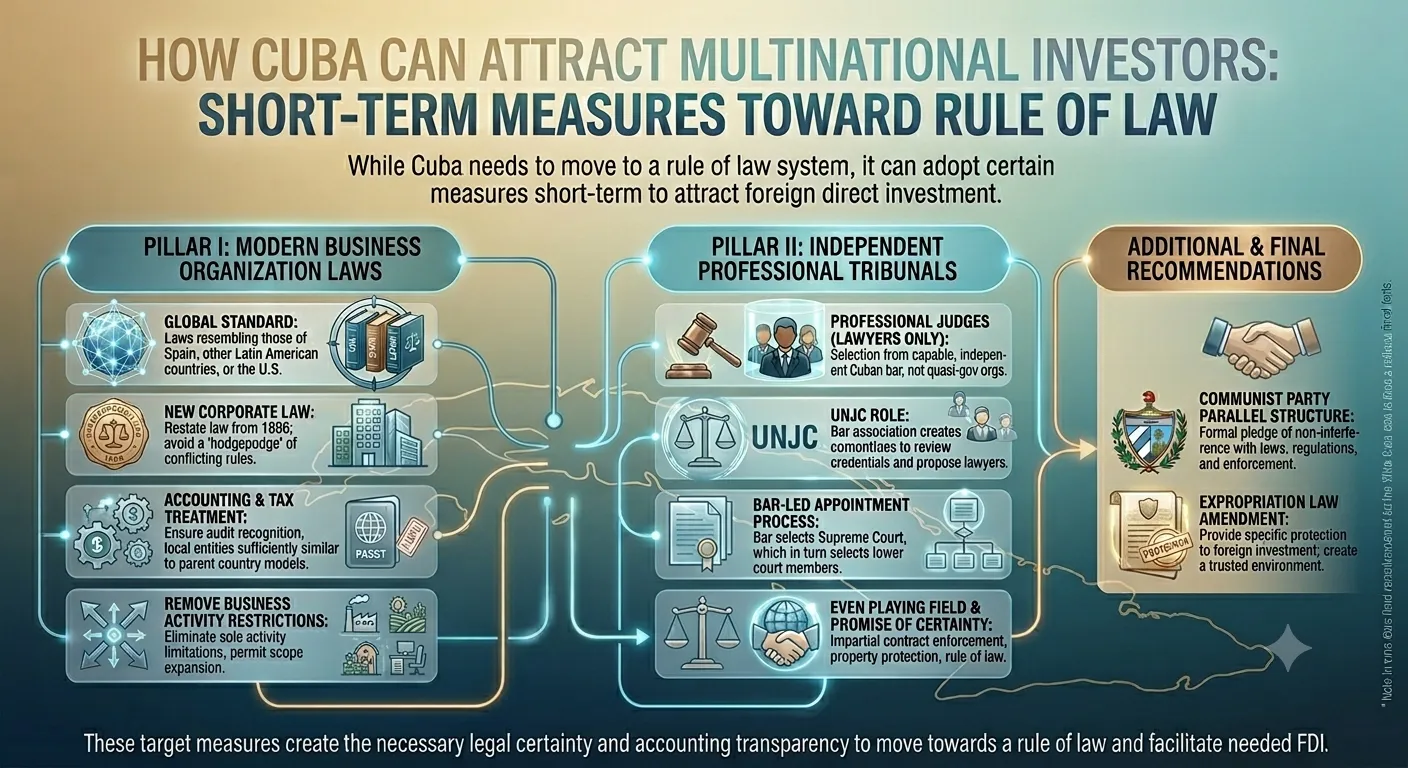
In sum, Cuba needs to adopt modern commercial laws, including modern business organization forms in order to facilitate the investments it wishes to attract from abroad. Since Cuba was a civil law system before the Revolution, it could well choose to look to the laws of Spain or those of other Latin American countries to draft its new commercial laws. In the alternative, it may well decide to look to U.S. law to adopt its corporate, limited liability and partnership laws. This might be attractive for a number of reasons: Cuba’s close financial ties to the U.S., the many commercial transactions between Cubans and the Cuban diaspora in the U.S., the remittances from this diaspora, and the fact that members of this diaspora are likely to be the initial capital source of many new enterprises started in Cuba.
It would be counterproductive for Cuba to take the position that it can build on the laws already adopted by merely modifying them again. For example, creating a new corporate law beginning with a law that was adopted for corporations in the 19th Century would be an onerous task given that some portion were subsequently repealed by other legislation and constitutional provisions and other portions were abrogated by yet other legislation, Moreover, the anonymous share corporation law was never restated as a complete law with modern corporate law provisions so that the actual rules governing a Cuban corporation could be determined by reference to one piece of legislation instead of a hodgepodge of conflicting laws, regulations, constitutional provisions – all of which suggests that the effort to build on what is already there would be time-consuming.
Independent Professional Tribunals
To the benefit of the economy and society, under a system of rule of law, the State protects investments, both local and foreign, by protecting property rights and enforcing contracts between economic actors. This dual enforcement role is accomplished by independent tribunals.
Independent tribunals allow for an even playing field, so that all those who chose to innovate and engage in commerce can do so without fear of unfair disadvantage. For example, the creation of robust legal institutions in the United States for its settlers resulted in widespread participation in the economy and a generally prosperous population.[11] South American countries with ample natural resources, on the other hand, developed extractive institutions to benefit their colonial powers. Subsequently, their local oligarchies concentrated power and resources in a small elite. As a result, robust legal systems did not develop and there was a lack of widespread economic participation and dynamism.[12]
Cuba’s current tribunals are not independent. They are comprised of persons recommended to and elected by the National Assembly and the majority of the members of the courts are not lawyers. While they have equal rights and duties with the lawyers on those tribunals, the non-lawyers do not have any academic preparation to know and apply the law. As members of the public at large, they are supposed to represent people’s justice. People’s justice, however well-meaning, is not the same as enforcing laws and applying rules by a tribunal of persons who know the law and understand its function and application. The participation of persons who consider they are “doing justice”, as opposed to applying pre-established rules, creates an inordinate element of uncertainty in the current Cuban legal system.
Fortunately, Cuba has a professional and well-informed legal bar. Courts could be recreated and judges selected from the bar’s very capable and independent members. The National Union of Jurists of Cuba (UNJC) is a non-governmental organization that represents and convenes legal professionals throughout Cuba. It has a current membership of 14,000, including law students, lawyers, judges, prosecutors and academics, all of whom pay dues.
The bar association has regular meetings dedicated to inform its members about legal developments nationally and abroad (although it focuses on the typical legal topics in a socialist system – history of law, constitutional law, contracts, administrative law); it holds seminars with foreign lawyers, and holds annual meetings. It also publishes compendiums of scholarly articles
The bar association itself could create committees to review legal credentials and propose lawyers to serve on the new courts, much as the American Bar Association makes recommendations in the U.S. These lawyers could then be elected to the courts by the National Assembly.
Another method of appointment would be that the bar association select the members of the Supreme Court and that, in turn, select the members of the lower courts, with the advice of the bar association. The judges on the Supreme Court would have an incentive to select members of the lower courts who are able to handle most cases effectively so that only a limited number of highly significant matters would come before it. The principal differences from the manner in which the courts are currently staffed is that the courts would be composed only of lawyers, would not report to the National Assembly, and that the lawyers recommended to serve on the courts would be selected by and from the members of the Cuban bar.
Conclusion and Recommendations
Creation of independent courts is particularly important in cases such as Cuba where there is a prior history of expropriation of private property. The presence of independent courts act like a binding promise to the investor of certainty that its property rights will be protected and its contracts fairly interpreted without favoring the State or any other powerful party to a dispute.
Another element of uncertainty that prevents Cuba’s qualification as a rule of law system is the existence of the parallel governmental structure of the Communist Party, many members of which are also government officials, as is typical in a Marxist-Leninist socialist system. What is the role of the parallel structure of the Communist Party with respect to the law? The preambles of the Cuban Constitution of 2019 states it is a fundamental pillar and guarantee of the Cuban economic, political and social order. In carrying out that role, does it have the power to overrule actions taken by the legislature or approvals granted by government agencies? If so, can the investor rely on the creation of legal structures under Cuban laws, regulations and government approvals to effect its investment in Cuba if the Communist Party has discretionary power?
While the Communist Party exists under the Constitution of 2019, a formal pledge by the Communist Party that it will not interfere with the laws adopted by the National Assembly and the regulations adopted by the ministries in enforcing those laws would give the investor the additional comfort it will need to make an investment under the current political order. Moreover, an amendment of Cuba’s law regarding expropriation will be needed to specifically provide protection to the foreign investment.
Part 1 provides a discussion on “What is and What is not Foreign Direct Investment”. Also, see Part 2 “Rule of Law” and Economic Development".
[1] Cubans will tell you that they have a franchise law because they recognize the existence of franchises and allow foreign companies to register franchises, but to date there is no franchise law under which franchises may be organized in Cuba. Similarly, they will say they have a corporate law because you can create a corporation by a contract among an enterprise’s investors, which is then registered and approved by the National Assembly of People’s Power. This, however, only binds the parties to the contract, not third parties such as creditors. Moreover, the specific terms of the contract are not known to the world, as is the case when you create a corporation under a corporate law where all of the key legal provisions are provided by the law. In most rule of law jurisdictions, the certificate of incorporation only contains those provisions that the corporation can chose: name, amount of capital stock, etc. All of the other provisions are contained in the corporation law under which the corporations are organized.
[2] While in other countries national assemblies appoint or ratify the appointment of judges, a system where judges report to another branch of government, such as in Cuba, would not be considered to be one with rule of law. In particular, foreign investors would not consider that they could rely on those courts in a transaction involving the State.
[3] Cuban Constitution of 2019, Chapter V The Tribunals of Justice; Cot, José R. and Anillo, editors, “Cuba: A Legal Guide to Business”, Section 1, para. 21. Thomson Reuters, 2016. See, also, "Guide to Cuban Law and Legal Research", International Journal of Legal Information, 2017.
[4] Cot, José R. and Anillo, editors, “Cuba: A Legal Guide to Business”, Section 1, para. 28 and 29. Thomson Reuters, 2016. See, also, "Guide to Cuban Law and Legal Research", International Journal of Legal Information, 2017.
[5] Cuban Law 498 adopted on August 19, 1959.
[6] It is important to note that requirements to get discretionary approvals lend themselves to corruption, particularly in transition economies.
[7] There are a few laws that apply to U.S. parents and all of their subsidiaries worldwide, including those incorporated abroad. Those are, generally, anti-corruption and anti-bribery laws and economic sanctions. There are also emerging regulations, such as those in the European Union, that impose strict data privacy protections and others that require companies to monitor environmental impacts, as well as human rights violation throughout their supply chain.
[8] The key features of a corporation (also known as a sociedad anónima in Spanish) are: separate legal existence from its owners, limited liability for its owners, perpetual existence, and freely transferable ownership shares.
[9] The corporation or limited liability company would still pay any applicable taxes in the local jurisdiction in which it organizes.
[10] Most multi-national corporations are publicly-held, which means their shares trade on a stock exchange and any person can buy or sell the shares.
[11] See, generally, Acemoglu, Daron and Robinson, James A., Why Nations Fail: The Origins of Power, Prosperity, and Poverty, Crown Publishers, 2012.
[12] Ibid; Phelps, Edmund S., Mass Flourishing, How Grassroot Innovation Created Jobs, Challenge, and Change, Princeton University Press, 2015