
What Should Be Prioritized in a First Phase of Economic Reforms in Cuba?
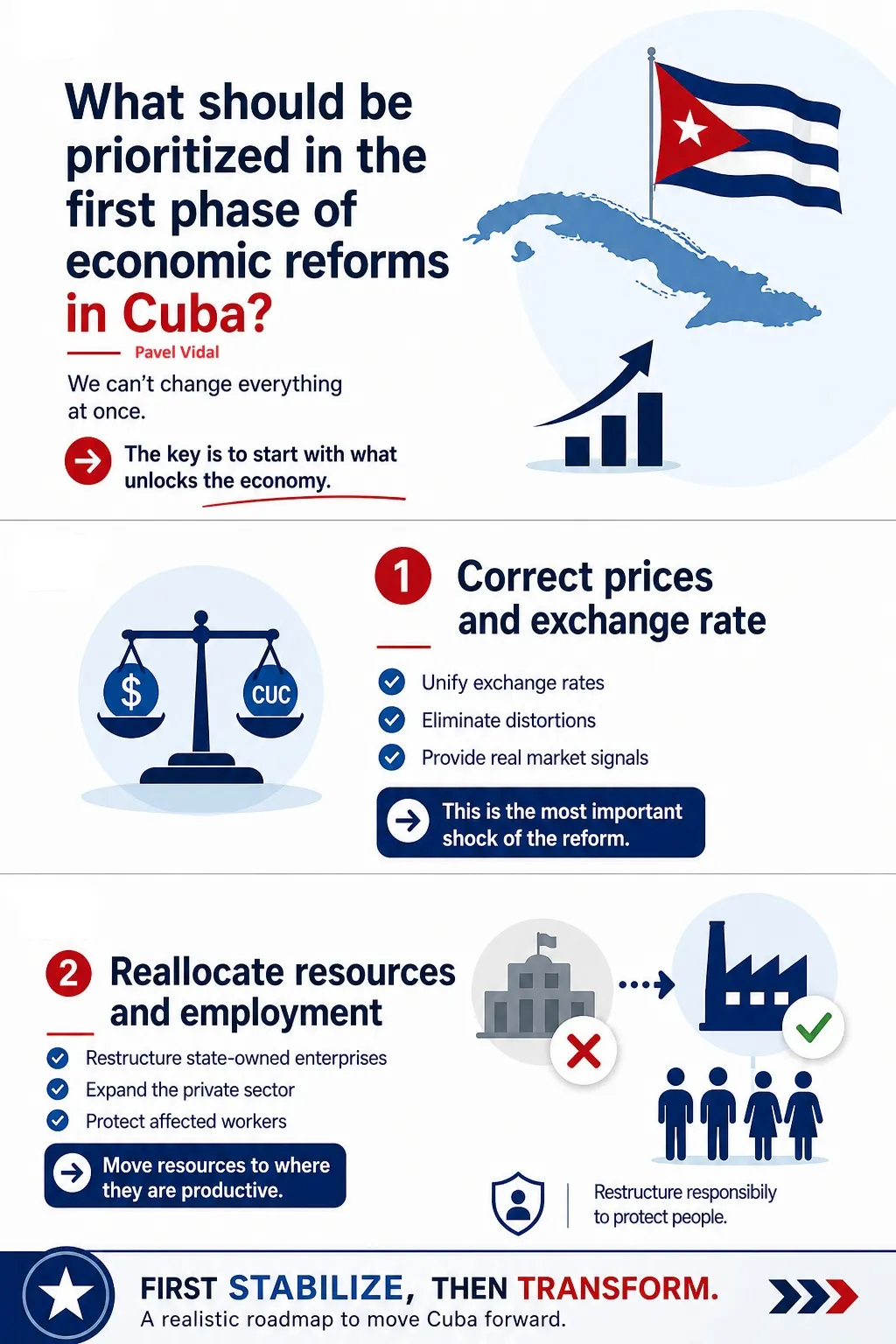
The first high-impact transformation that should be taken in Cuba is the correction of relative prices and the exchange rate. This would likely constitute the most significant shock in a market-oriented reform.
By 2026, a set of international conditions has combined with the worsening economic, social, and political crisis in Cuba, increasing the likelihood of a deeper economic transformation. Yet it is difficult to predict the specific political scenario in which such changes might occur.
From an economic standpoint, however, it is both possible and necessary to develop a roadmap that identifies the phases of a potential transformation and the priorities that should guide each of them.
Prominent Cuban economists recently presented a preliminary version of such a three-phase roadmap at the Cuba Study Group in Miami. The first phase would involve stabilization and emergency transformations; the second, a broader process of productive reactivation; and the third, a phase aimed at strategically defining the long-term economic and social development model for the country.
This sequencing is based on a fundamental premise: the Cuban economy cannot simultaneously correct all accumulated macroeconomic imbalances, restore deteriorated infrastructure and productive capacity, reverse the social costs of the crisis, and immediately create the institutional, regulatory, and conditions for transparency and predictability required for large-scale international capital and investment.
In any transformation process, institutional, human, and financial capacities to design, coordinate, and scale reforms are limited. The sequence of changes must be neither excessively slow—as has been the case to date—nor devolve into a disorganized and chaotic process of liberalization and privatization that could deepen the productive contraction, increase social costs, and create opportunities for rent capture by elites.
Amid an ongoing negotiation process between the Cuban government and the United States—whose final scope remains uncertain—it is useful to propose, from a technical economic perspective, a roadmap outlining the transformations that should be prioritized in a first phase of economic change in Cuba, should a window of opportunity for reform emerge.
Proposals of this kind may be useful to both parties. Without replacing political negotiation, a reform roadmap can help provide structured economic content to dialogue and better delineate areas of potential agreement.
Two Structural Transformations to Prioritize in the First Phase
In this initial phase of stabilization and emergency transformation, objectives must be achievable and consistent using the critical starting point of the existing Cuban economy.
This requires acknowledging the accumulated deterioration of the country’s economic and social infrastructure, visible in the electricity system, transportation, housing, water systems, logistics networks, and healthcare services.
It also entails recognizing the loss of human capital due to emigration and population aging, as well as the low competitiveness and technological obsolescence of most economic sectors.
Additionally, it requires recognizing that some correction of fiscal and monetary imbalances has already occurred, albeit incompletely and at high social cost. Inflation and exchange rate depreciation have moderated from previous peaks, but largely as a result of impoverishment rather than due to a coherent stabilization program.
For this reason, stabilization in this first phase should not be understood in a narrowly monetary sense. It is not only about reducing inflation or fiscal deficits. Under current Cuban conditions, stabilization also means halting the deterioration of productive supply, ensuring a minimum level of social conditions for households, and generating basic confidence for the successful operation of the private sector and small-scale international capital.
Within a two- to three-year horizon, it is unrealistic to expect Cuba to complete all the institutional, regulatory, and political transformations required for a fully functional environment in order to attract large-scale capital or to redefine its international integration model. These deeper changes must be addressed in later phases.
However, it is feasible from the outset to introduce reforms that strengthen the existing private sector, which is currently one of the few areas capable of adapting, generating supply, employment, and income.
It is also reasonable to expect that part of the Cuban diaspora—with its capital, networks, and business expertise—could begin investing even in this high-risk environment, provided that opportunities for a return on investment are opened and clearer rules and minimum legal guarantees are established.
At a structural level, this first phase should prioritize two high-impact transformations.
The first is the correction of relative prices and the exchange rate. This would likely constitute the most significant shock in a market reform process.
In terms of exchange policy, it would resemble the 2021 “monetary reordering,” insofar as it would involve correcting distortions in the price system and unifying exchange rates. However, unlike that process, this correction should be accompanied by economic liberalization, allowing the private sector, agriculture, and other productive actors to respond to new market incentives and signals.
The second major transformation would be advancing the reallocation of resources and employment within the productive structure. Although rapid privatization is not recommended at this stage, it would be necessary to close, merge, or restructure state-owned enterprises that are not profitable once relative prices and exchange rates are corrected.
This process would inevitably create a shock in employment and in the organization of the productive system. However, it could and should be mitigated through two complementary mechanisms: first, the rapid expansion of economic activity space for the private sector so that it can absorb excess labor and resources from those restructurings; and second, the creation of temporary subsidies and support mechanisms for workers affected by the restructurings.
A particularly complex component of this phase is the treatment of GAESA (Grupo de Administración Empresarial, S.A.). Given the weight of this military-run conglomerate in strategic sectors of the Cuban economy—including the financial system, tourism, foreign trade, and control of international reserves—it would be neither logical nor effective to design a productive national transformation that excludes it.
If reforms are to achieve macroeconomic credibility, productive coherence, and social legitimacy, it will be necessary to move toward dismantling GAESA, reducing its monopolistic control, and transferring its functions to more transparent civilian structures.
The speed and extent of this process, however, will depend on the balance of power emerging from political negotiations and the type of agreements reached with the United States.
Criteria for Defining Additional Reforms in the First Phase
Alongside these two major structural transformations, the first phase also requires the country to adopt complementary policies in the monetary, fiscal, and foreign investment areas.
It will also be necessary to prioritize reforms in key sectors such as energy, agriculture, and tourism—the latter is particularly important due to its existing capacity and its potential to benefit from any easing of sanctions.
Additionally, the country must develop social policies to mitigate the costs of adjustment and ensure minimum protection for vulnerable groups.
In this context, the following nine criteria provide a basis for selecting the policies and reforms to prioritize in this initial phase:
1. Severity of the problem being addressed. Reforms should prioritize addressing the most severe imbalances and the most urgent deficiencies in the Cuban economy.
2. Institutional capacity for implementation. In the initial phase, policymakers should prioritize measures whose implementation, oversight, and coordination require lower levels of institutional capacity. They can defer more complex reforms—administratively, regulatorily, or operationally—to later phases.
3. Ability to mobilize financial resources. Policymakers should favor reforms that they can support with available resources or with resources they can reasonably secure in the short term, whether through easing sanctions, accessing credit, attracting investment, generating or saving foreign currency, reallocating domestic resources more efficiently, or obtaining targeted international assistance.
4. Availability of infrastructure and existing physical capital. Reforms should prioritize sectors or activities that already have a minimum base of infrastructure, equipment, logistical capacity, or usable physical assets. This reduces startup costs, facilitates implementation, and allows for quicker results.
5. Compatibility with demographic and human capital constraints. Policymakers should prioritize reforms consistent with the actual availability of labor, occupational profiles, and the country’s technical capabilities. Emigration, population aging, and skill gaps limit the feasibility of transformations that require large volumes of labor or highly specialized professions.
6. Multiplier effects on the rest of the economy. Reforms that, when applied in a specific area, generate positive spillovers in other sectors or help resolve multiple bottlenecks simultaneously should receive higher priority. The objective is to favor measures capable of unlocking broader processes of stabilization and recovery.
7. Expected speed of results. In the initial stage, policymakers should prioritize measures capable of producing relatively rapid effects on stabilization, productive supply, and the provision of essential goods and services, while also building confidence and support for the reform process.
8. Impact on welfare and social legitimacy. Reforms that more clearly help halt the deterioration of living standards, protect the most vulnerable groups, and distribute the costs of adjustment more equitably should receive priority. Policymakers should also weigh their capacity to sustain social legitimacy, since reforms that concentrate benefits among a few actors or shift disproportionate costs onto households tend to lose support and face greater risks of blockage or reversal.
9. Supporting international evidence and precedents. Policymakers should prioritize reforms backed by successful international experience or by comparative lessons useful for their design and implementation. International evidence does not replace analysis of the Cuban case, but it helps identify policies with a higher likelihood of success.