
The Basic Basket and the Average Salary in Cuba
The estimated basic basket – the essential, affordable items needed to meet the minimum dietary requirements for a household - costs at least 14 times the average salary in Cuba. According to international publications, less than 5% of the Cuban population can count on the equivalent of $3 per day, placing virtually all of us below the poverty threshold.

Introduction
An analysis of the basic basket of foods necessary for meeting the minimum dietary requirements in Cuba is essential to determine whether it ensures sufficient and balanced nutrition for the population in a context of economic constraints and variable food availability (the "estimated basic basket"). The goal is to identify potential deficits in energy and essential nutrients, as well as imbalances in the diet that may affect public health.
Another purpose of this study is to provide, drawing on international scientific standards, a basis for guiding both individual decisions and public policy. The analysis uses as its framework evidence developed by the World Health Organization (WHO), the Food and Agriculture Organization of the United Nations (FAO), and the National Academy of Medicine (previously, the "Institute of Medicine"), complemented by the practical approach promoted by the Harvard T.H. Chan School of Public Health. This allows for an assessment of both the quantitative sufficiency and qualitative balance of the diet, expressed in the quantities required per person per month.
Moreover, the analysis extends beyond food to include other essential components of everyday well-being. It examines access to medicine, products for personal hygiene and household cleaning, clothing and footwear, as well as coverage of transportation costs, with the aim of providing a more comprehensive view of existing living conditions and the basic needs of the population.
The basic food components in the estimated basic basket are analyzed from a comprehensive nutritional perspective, evaluating the food basket’s capacity to meet the population’s energy and essential nutrient requirements.
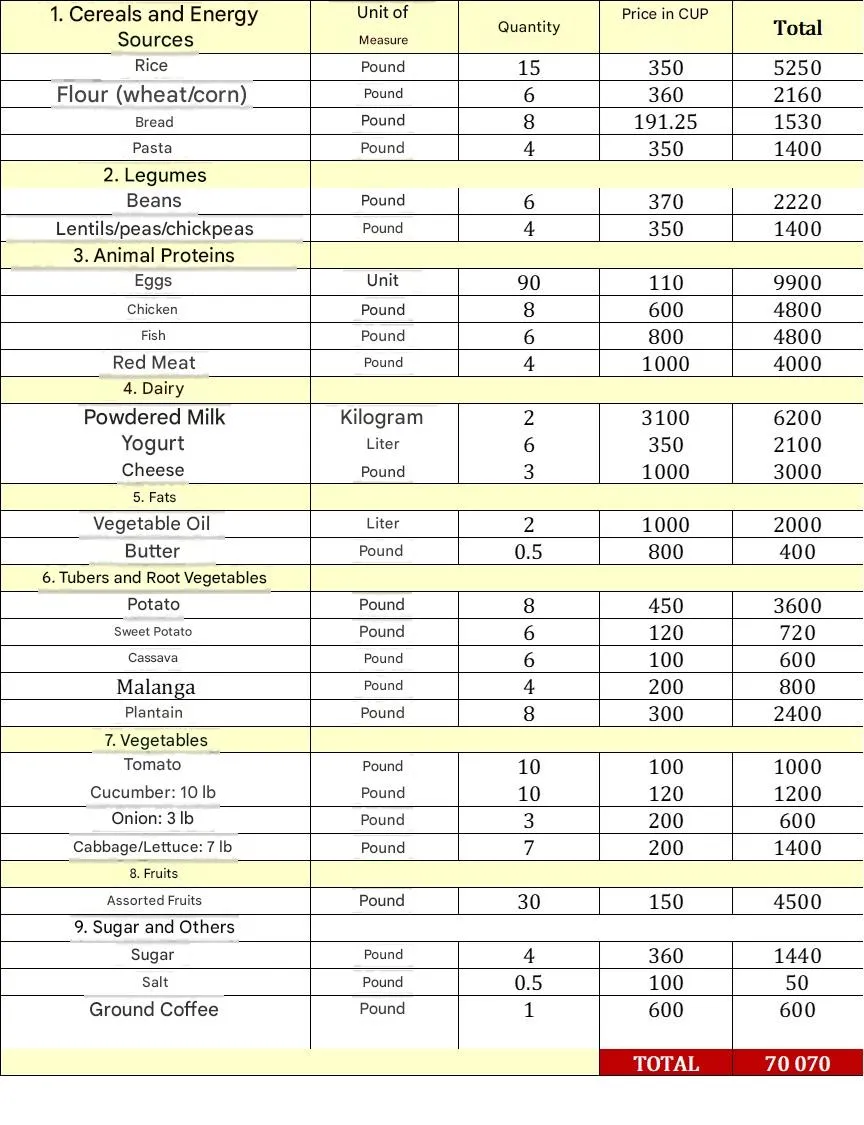
The selection is based on products available in the domestic market, with prices collected through a survey in 51 municipalities across all provinces. Values are expressed in Cuban pesos (CUP) and calculated as weighted averages, which allows a more accurate picture of the diversity and fragmentation of the market.
Table 1 Food Costs
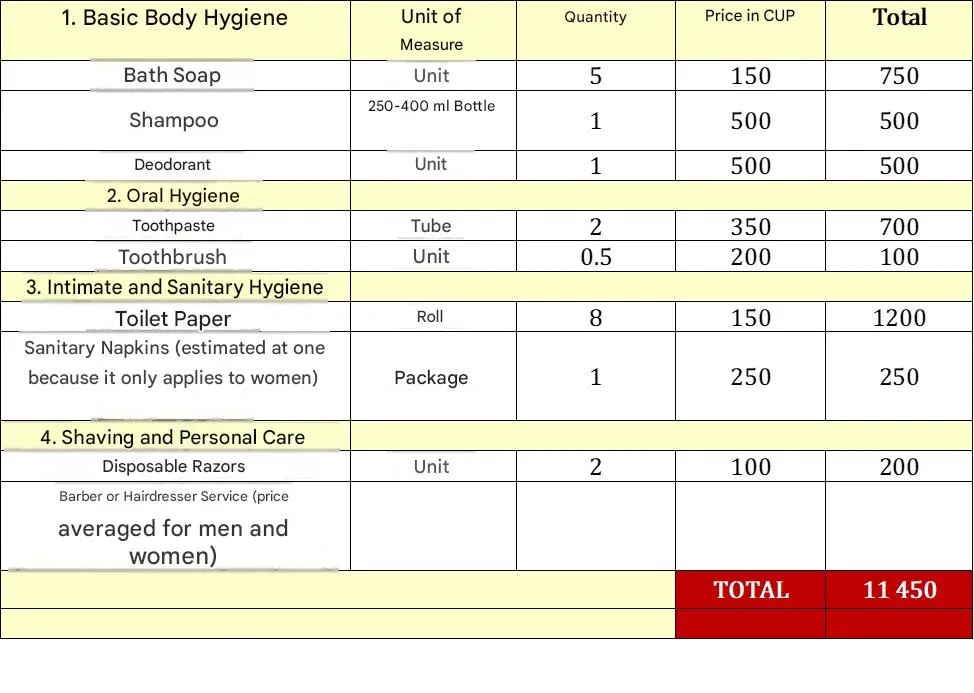
The estimate basic basket also includes personal hygiene products essential to guarantee minimum standards of health and cleanliness—such as soap, shampoo, toothpaste, and deodorant, whose availability directly affects quality of life of individuals The analysis focuses on their affordability and their accessibility to meet basic hygiene needs.
Table 2 Personal Hygiene Costs
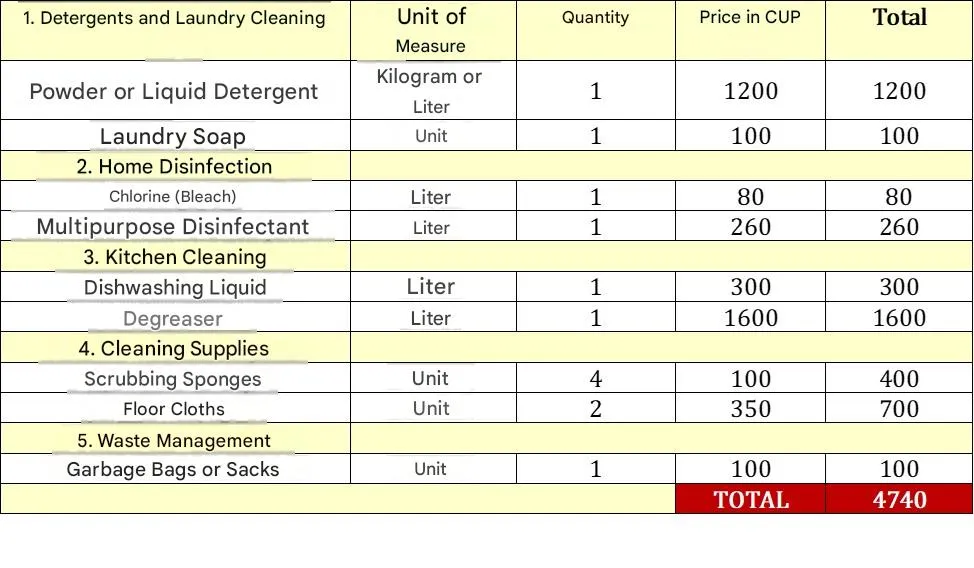
Another essential component is household cleaning supplies, including detergents, disinfectants, and basic tools such as mops and brooms. These are necessary to maintain sanitary conditions and prevent disease.
Table 3 Household Cleaning Costs
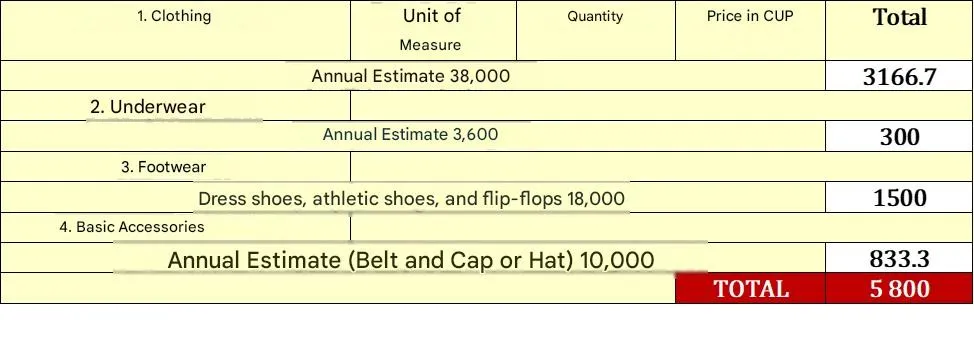
Clothing and footwear are considered essential goods for a dignified life. The analysis examines both availability and cost, emphasizing their role in both bodily protection and cultural expression.
Table 4 Clothing and Footwear
Access to medicines is a fundamental component of the estimated basic basket, as continued health depends on the ability to obtain essential drugs. The study includes commonly used medications such as analgesics, antibiotics, and antihypertensives, as well as treatments for chronic conditions like hypertension and diabetes.
The study was based on the relation between prices, access, institutional availability, the tension between social demand and limited availability. As a result, a direct and conservative estimate of 2,000 CUP was established.
Finally, transportation costs are considered, as they are essential for people’s mobility and access to goods and services. Expenses associated with both public and private transportation were evaluated, as well as their impact on household budgets. This component reflects not only the economic dimension but also the population’s capacity for social and territorial integration. In this case, a conservative estimate of 2,000 CUP was also used.
Adding the total values from each table, plus the estimated 4,000 CUP for medicines and transportation, yields an approximate value of the estimated basic basket in Cuba of 96,060 CUP.
Limitations of the Estimate
The estimate does not include several important categories of goods:
- Beverages (alcoholic or non-alcoholic)
- Cigarettes
- Complementary food products (such as condiments and processed foods)
(As can be seen by the preceding list of items omitted items, the food estimate is conservative and does not represent a fully diversified diet.)
Additional exclusions are:
- Recreation and leisure expenses
- Household textiles (e.g., bedding)
- Other personal care products, such as creams, talcum powder, among others
- Kitchen utensils and tableware
- Basic utilities (electricity, water, telecommunications, Internet)
- Cosmetics and perfumes
- Appliances and their replacements
- Interprovincial transportation
- Durable cleaning tools and home maintenance materials (brooms, buckets, mops)
- Materials for home maintenance (paint, cables, locks, screws, nails, etc.)
- Additional energy sources (charcoal, kerosene, domestic fuel)
- Note that the estimates for clothing and footwear are lower than those used in international standards.
(The preceding five elements are nonetheless essential as they are necessary for a functioning home.)
(For reference, a roundtrip fare between Guantanamo and Havana can cost 100,000 CUP, far exceeding the annual salary of most workers.)
(These omissions are significant, as they represent unavoidable household expenses and imply that the estimate understates the true cost of living.)
- Personal tools or specialized work materials
- Expenses on miscellaneous services such as repairs (appliances, footwear, watches), or minor consumables
- Jewelry and costume accessories
Conclusions
From a nutritional standpoint, the estimated basic basket meets minimum energy and macronutrient requirements, but by its conservative design, excludes many other common foods and costs associated with typical daily life. Nonetheless, by incorporating hygiene, clothing, medicines, and transportation, the analysis adopts a more comprehensive approach to well-being than it would if it were just limited to food intake.
The cost of the estimated basic basket (96,060 CUP), which is grounded in empirical data and international standards, reveals a critical gap between it, as a reflection of the cost of living, and the purchasing power of the average Cuban. In practice, the estimated basic basket is unaffordable for nearly all Cubans, limiting its usefulness as a realistic benchmark for consumption.
As acknowledged above, these calculations understate the true cost of living in Cuba. The estimated basic basket therefore represents only a minimal survival threshold, insufficient to meet essential needs in everyday life.
No Cuban can live on his or her salary according to this estimate: the estimated basic basket costs at least 14 times the average wage. Moreover, more than 95% of the Cuban population earns the equivalent of $3 per day, placing almost the entire population below the poverty line, as determined by international standards.

Javier Pérez Capdevila. Holds a Ph.D. in Economic Sciences from the University of Oriente (Santiago de Cuba) and is an Honorary Member of the Cuban Academy of Sciences. His areas of expertise include economics, management theory, and the mathematical modeling of social phenomena. His research focuses on economic analysis, applied mathematics, education, governance, and the impacts of structural crises.
He has carried out extensive academic and scientific work internationally, serving as a visiting professor at the University of Cartagena, an honorary member of the Colombian Network of Accounting Research, and an honorary professor at the COMFENALCO Technological University Foundation. He has also collaborated on science, technology, and innovation projects with the Complutense University of Madrid, the Polytechnic University of Madrid, and the University of Alcalá.