
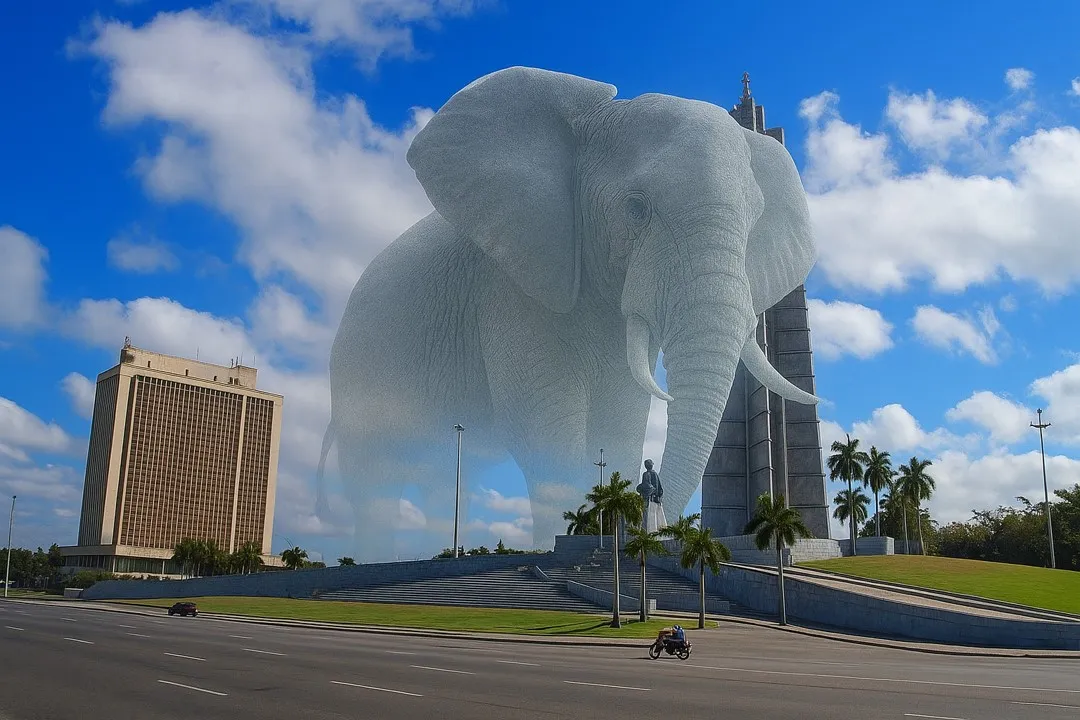
GAESA, the Invisible Elephant in Cuba’s Macroeconomic Stabilization
The new Government Program recently presented by the Cuban authorities aims to reduce inflation and the fiscal deficit, and to address monetary issues. However, it does not even mention the GAESA military conglomerate or considers its key role in the national economy.
This year’s leak of the financial statements of the GAESA military business conglomerate, published by El Nuevo Herald, offers for the first time a quantitative window into the finances of Cuba’s most powerful military-run economic group [1] . The balance sheets for 2023 and 2024 make it possible to project with more accuracy a magnitude that for years had only been supposed.
The GAESA conglomerate dominates the country’s most strategic and profitable economic sectors. Through its affiliate Gaviota (Grupo de Turismo Gaviota S.A.), it controls a large share of tourism; through affiliates CIMEX and TRD Caribe, retail and wholesale trade, respectively; and through RAFIN S.A. and the Banco Financiero Internacional (BFI), the Cuban financial system.
It also manages remittance businesses, logistics, and storage—including the Port of Mariel—while participating in construction, transportation, and foreign trade. In practice, it administers the country’s main foreign-currency flows, making it the most influential economic actor in Cuba.
GAESA’s gross profits on sales represent close to 37% of Cuba’s GDP, which means that more than one-third of the country’s total value added is generated within the military conglomerate.
The GAESA group’s exports of goods and services are equivalent to approximately 34% of the island’s total exports, and, if only services taken into account, its share rises to 41%. GAESA’s total revenues are 3.2 times greater than the annual revenues of the Cuban State Budget. [2]
The GAESA military-run business conglomerate reports liquid dollar reserves of USD 14.5 billion, confirming the scale of the financial resources under its control.
This economic power operates, moreover, under complete institutional opacity: GAESA is not subject to audits by the Office of the Comptroller General, nor does it report to the Cuban National Assembly. Its financial operations, profits, and reserves are managed under a framework parallel to that of the rest of the State and the civilian economy.
In a context of a deep crisis in Cuba—shortages, blackouts, inflation, default on external debt, and the collapse of the convertibility of national currencies—the GAESA conglomerate maintains positive profits, finances hotel investments, and accumulates financial surpluses, while the rest of the economic system lacks the foreign currency needed to operate.
How Is It Possible for GAESA to Accumulate Such Large Profits and Reserves?
GAESA’s extraordinary profits and commercial margins are explained by the very nature of the conglomerate and by the institutional conditions under which it operates.
The military conglomerate is not just another enterprise within the Cuban state system. It is an economic, financial, and military structure with privileged access to foreign currency, captive markets, and its own regulatory regime, placing it beyond the reach of public oversight.
GAESA operates without competition in most of the sectors in which it is present. It sets prices and conditions, captures high profit margins, and dominates access to foreign currency. Its monopolistic position eliminates any market discipline and allows it to transfer rents from the rest of the economy into its own conglomerate.
Since 2008, with Raúl Castro’s rise to power, the conglomerate began to expand rapidly, absorbing other business groups and extending its control to new strategic sectors. Its growth therefore responded not only to business need or economic efficiency, but also to a deliberate political strategy to centralize the most profitable assets under military structures.
Another factor explaining its high profits and reserves is monetary duality. Most of GAESA’s personnel are paid salaries in national currency, while business revenues largely come from sales denominated in dollars or MLC (a so called freely convertible currency that is represented by a debit card). GAESA exploits exchange-rate gaps to expand its commercial margins to an extraordinary degree.
GAESA’s financial results clarify the country’s investment pattern in recent years. Projects under its control have absorbed most of the nation’s investment funds. This orientation of capital spending largely explains the structural distortion of national investment: while agriculture, manufacturing, energy, and basic services lack resources, the hotel sector has enjoyed continuous financing.
The leaked balance sheets show that GAESA’s foreign-currency reserves have fluctuated between USD 9 billion and USD 14.5 billion. Part of these reserves constitute working capital and liquidity needed for import operations, merchandise flows, and financial sustainability; this portion responds to a business and operational objectives.
Consequently, not all of this amount is excess cash reserve [retained earnings]; rather, it reflects the size of GAESA’s enterprises (which account for nearly 40% of Cuba’s GDP) and to their strong presence in key sectors such as tourism, trade, and finance.
Moreover, while part of these funds corresponds to working capital and liquidity that GAESA requires for its operations, it must also be understood that this is where the country’s international reserves are located—reserves that are not in the hands of the Central Bank of Cuba.
Fiscal and Monetary Implications of GAESA’s Omission from the Government Program
The new Government Program presented by the Cuban authorities in October, 2025 aims to reduce inflation, the fiscal deficit, and address monetary issues. [3] It proposes a fiscal and monetary adjustment program, but without mentioning GAESA or directly considering its role in the national economy. This omission is not minor: it implies leaving outside the macroeconomic policy framework the conglomerate that concentrates 40% of Cuba’s production, foreign trade, and financial activity.
GAESA does not pay taxes, nor does it transfer dividends to the State Budget. According to the leaked balance sheets, its total revenues are 3.2 times greater than the annual revenues of the State Budget, yet there is no proposal to channel these resources into public finances.
The Government Program does not address this fiscal void. This means that the burden of the proposed fiscal adjustment will continue to fall asymmetrically on the rest of the actors in the economy—state-owned enterprises, MSMEs, and households—which do contribute through taxes and other fiscal and non-fiscal mechanisms. In particular, households have borne the “inflation tax” resulting from the monetization of the fiscal deficit. [4]

By excluding GAESA’s financial results, social spending, public-sector wages, pensions, and investment in basic infrastructure depend on an impoverished budget, while the country’s most dynamic and profitable resources remain beyond its reach. In economic terms, this means that Cuban fiscal policy is designed around only 60% of GDP, leaving the remaining 40%—controlled by GAESA—outside any commitment to fiscal consolidation.
Something similar occurs in the monetary sphere. The Government Program sets monetary and exchange-rate objectives, but without resolving the distortion created by the location of foreign-currency reserves under the control of the military conglomerate rather than the Central Bank.
International reserves are, by definition, external assets controlled by monetary authorities and available for exchange-rate intervention, backing the national currency, meeting external obligations, and managing financial crises.
GAESA’s reserves, however, do not fulfill these functions: they were not used to prevent the collapse of the convertibility of the CUC (Cuban convertible peso) and the MLC, they did not support the 2021 monetary reform, and they have not been used to stabilize the banking system or international payments.
The Central Bank cannot meet the objectives of monetary and exchange-rate policy or contribute to macroeconomic stabilization as long as the country’s foreign currency is retained by a business conglomerate for purposes that remain unknown.
The Government Program’s silence on GAESA reflects not only a technical problem, but also a political choice. Incorporating the conglomerate into a stabilization program would imply redefining the structure of economic and military power—something those who designed the Government Program know they cannot touch.