
Finding a Color for the Cuban Economy
If a transition takes place, the question is whether change is orderly and guided by a vision or chaotic and reactive. History suggests that Cuba has rarely had the luxury of choosing.
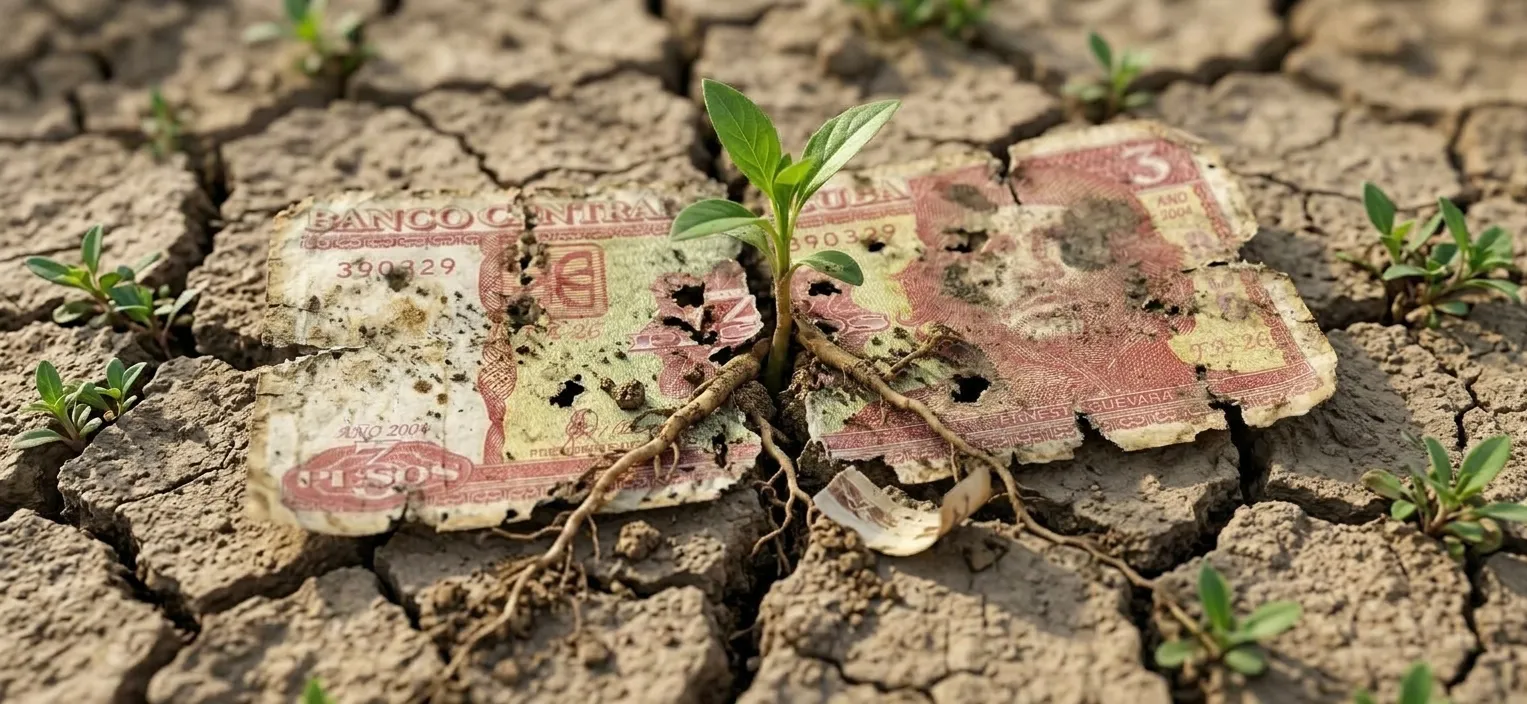
For more than a century, the Cuban economy has served as a laboratory for development models. It has moved from an export-oriented agricultural monoculture under U.S. influence to Soviet-style socialism and centralized planning, and then to a hybrid system of services, tourism, and remittances that has now collapsed under its own inefficiency.
In each period, Cuba's Gross Domestic Product (GDP) has been profoundly shaped by the way the country consumes, transforms, and depends on its natural resources: forests, soil, energy, and biodiversity.
This article compares Cuba's GDP and the pressures placed on its natural capital resources during three periods—1930–1960, 1960–1990, and 1990–2020—to propose, based on the evidence from its historical trajectory and the current crisis, a socioeconomic development model for Cuba's future.
This is an initial attempt to compare the historical relationship between GDP and the consumption of natural resources (1930–2020) with a proposal for the future[1].
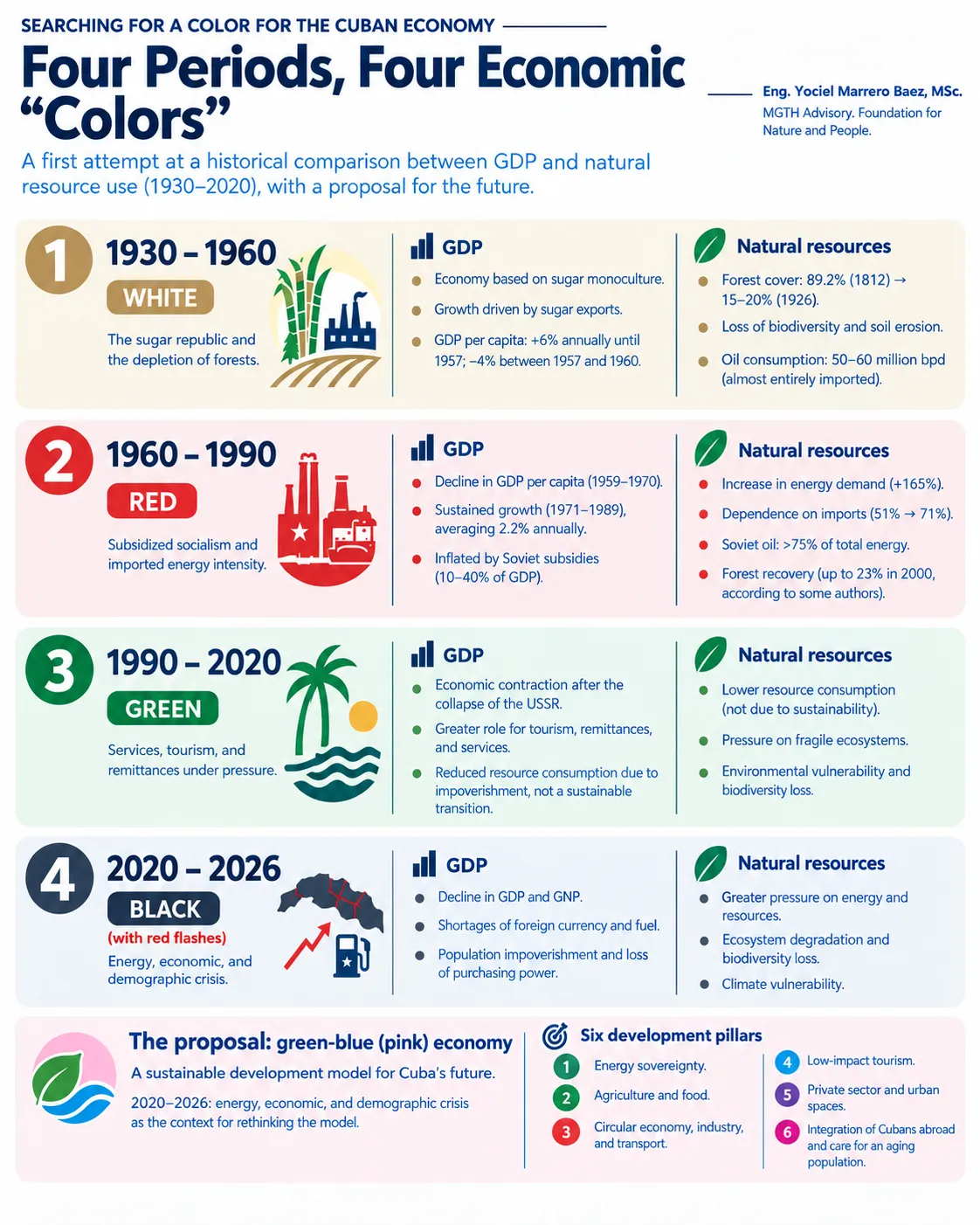
Four Periods, Four Economic “Colors”
I. 1930–1960 (White–Sugar): The Sugar Republic and the Depletion of Forests
GDP
During the first third of the twentieth century, Cuba was one of Latin America's most prosperous economies. GDP was directly linked to sugar exports, which accounted for more than 30% of national income. The Great Depression of 1929 caused a severe contraction in GDP, but exports accelerated during the 1940s due to increased demand during of World War II.
Per capita GDP grew by 6% annually until 1957, before declining by 4% between 1957 and 1960 as a result of armed conflict in the country. In 1958, Cuba had a per capita GDP of $2,363, placing it in the middle of the Latin American rankings.
Consumption of Natural Resources
This growth came at a devastating environmental cost. Since colonization, Cuba had been almost completely covered by forests—89.2% of its territory in 1812—but the expansion of sugarcane, coffee, and tobacco cultivation reduced forest cover to 54% in 1900 and to just 15–20% by 1926 (Dalhousie University, Environment & Society).
The neocolonial regime imposed through the Platt Amendment facilitated intensive exploitation of land and agricultural resources by foreign investors.
Biodiversity loss, soil erosion, and the depletion of natural fertility accompanied GDP growth in the sugar sector. Oil consumption in 1959—an exceptionally high figure, with approximately 60,000 barrels per day—was almost entirely supplied through imports.
Assessment
The economic model was based on the extraction of income through raw-material exports and dependence on foreign capital. GDP grew, but the ecological foundation of that growth deteriorated. Cuba consumed its forests to build sugar mills and feed its boilers, extracting the fertility of its soil to export it in the form of sugar.
II. 1960–1990 (Red–Socialist): Subsidized Socialism and Imported Energy Intensity
GDP
After the 1959 Revolution, Cuba reorganized its economy around central planning and alignment with the Soviet bloc. GDP growth was uneven: per capita GDP fell to an average of −0.7% between 1959 and 1970, including a 21% decline in 1969–1970, when the country sought (and failed) to produce 10 million tons of sugar in 1970.
Then, between 1971 and 1989, per capita GDP grew by an annual average of 2.2%, exceeding the Latin American average of 1.3%. In nominal terms—not directly comparable with figures from other periods because of methodological differences—GDP rose from approximately $5.7 billion in 1970 to $28.6 billion in 1990.
However, Soviet subsidies artificially inflated this growth, accounting for between 10% and 40% of Cuban GDP in different years, with an estimated total of $65 billion between 1960 and 1990 (which was more than three times the U.S. aid provided to all of Latin America through the Alliance for Progress).
Consumption of Natural Resources
Energy dependence deepened dramatically. Energy demand increased by more than 165%, rising from 107,000 barrels per day in 1957 to 286,000 barrels per day in 1980. Total primary energy supply (TPES) increased from 10,934 kilotonnes of oil equivalent (ktoe) in 1971 to a peak of 16,877 ktoe in 1989.
Dependence on energy imports rose from 51% in 1970 to 71% in 1985. Subsidized Soviet oil supplied more than 75% of the island's total energy consumption. Cuba even reexported surplus Soviet oil to Western Europe at market prices to obtain dollars.
According to some articles citing official sources, forest cover began to recover during this period through state reforestation programs, and by 2000 total forest cover had increased to 23%, although other authors suggest that the forest-to-territory ratio remained around the 14% forest cover of 1959.
Assessment
The model depended on subsidized growth. GDP increased steadily through external transfers (cheap oil, inflated sugar prices, and Soviet loans), but the economy failed to generate autonomous productivity.
Material and energy intensity was extremely high: Cuba consumed more energy per capita than many countries with similar incomes, yet achieved relatively low productivity.
Reforestation was a rare achievement, but the carbon and material footprint of the economy remained unsustainable without external subsidies.
III. 1990–2020 (Green–Intermediate): The Special Period, the Shift Toward Services, and “Resilience”
GDP
The collapse of the Soviet Union in 1991 triggered the largest economic contraction in Cuban history: GDP fell by 33% between 1990 and 1993 and Cubans refer to it as the "Special Period".[2]
Annual growth rates were catastrophic. The economy began recovering only in 1994, with average annual growth of 3.4% through 1999, driven by tourism, remittances, and foreign investment.
During the 2000s, with Venezuelan and Chinese support, GDP grew by an average of 5.3% annually. In nominal terms, GDP rose from approximately $107 billion in 2017 to $202 billion in 2020, but since 2018 the economy has contracted by more than 10% cumulatively, and in 2020 it suffered a 10.9% decline.
Average annual growth during the two decades after 1994 was only 1.8%, among the lowest rates in Latin America.
Consumption of Natural Resources
The Soviet collapse caused a drastic reduction in resource consumption. Imports of energy fell from 11 million tons of oil equivalent (toe) in 1990 to 5.9 million in 1993. TPES declined by 20%, and blackouts became commonplace.
The Special Period forced Cuba to develop agricultural practices with a smaller environmental footprint: urban and organic agriculture, animal traction, and reduced use of agrochemicals.
Nevertheless, as the economy recovered as a result of receiving subsidized Venezuelan oil, many of these practices were abandoned. By 2002, 78.2% of energy supplies came from fossil fuels, and 93.3% of electricity generation relied on thermoelectric power.
Domestic oil consumption reached 209,000 barrels per day in 2003, but domestic production covered only a small fraction.
Assessment
The economic model was one of forced adjustment and a shift toward services. Following the collapse of Soviet subsidies, Cuba moved toward services (tourism, exports of medical services, etc.) and dependence on remittances.
Nickel and biotechnology replaced sugar as leading sectors. Natural resource consumption declined because of economic impoverishment, not because of sustainable development.
The economy survived without structural reform: without energy sovereignty, a competitive industrial base, or an agricultural sector capable of feeding the population.
IV. 2020–2026 (Black with Red Highlights): The Current Crisis, the Collapse Nobody Wanted to See
The crisis Cuba is experiencing today surpasses the Special Period of the 1990s in many respects. In July 2026, the island suffered its third nationwide blackout in less than two weeks, leaving approximately 10 million people without electricity.
The blockade of oil supplies through the Florida Straits, following the end of Venezuelan and Mexican shipments, together with thermoelectric power plants—many dating from the 1960s and 1980s—left the country “blind, deaf, and on crutches,” in the words of Professor Jorge Piñón.
The demographic crisis is equally devastating. According to data from Cuba's National Office of Statistics and Information (ONEI), the population declined in 2025 by 9,434 inhabitants, a decrease of 1.6% since 2021. In 2025, 80,017 births were recorded, compared with 134,354 deaths, and net migration stood at −245,264 people.
According to demographer Juan Carlos Albizu-Campos, approximately 2.75 million people have left the island since 2020. According to World from PRX, citing UN data, nearly 3 million people lack regular access to safe water.
In response to the collapse, the National Assembly of People's Power approved the broadest market liberalization measures in more than six decades: legalization of private commercial banks, opening of an official foreign exchange market, and elimination of the universal subsidy system.
The tacit acknowledgment is clear: the existing model has failed.
Toward a New Color: A Proposed Development Model
V. Prediction and Proposal: Toward a Green–Blue (Pink) Economy for Cuba
If a political and institutional transition takes place—an increasingly likely scenario, given the exhaustion of the model and external pressures—Cuba should not simply replace the current model with the neoliberal capitalist model that has caused so much harm in other Caribbean and Latin American countries.
Nor can it repeat the failed experiment of 1930–1960, or the subsidized dependence of 1960–1990. History offers a lesson: every time Cuba has tied its growth to a single external source of resources—the U.S. sugar market, Soviet oil, Venezuelan crude oil—the collapse has been inevitable when that source has been interrupted.
Cuba needs a model that combines economic growth, environmental sustainability, and social justice.
The proposal is a green–blue (pink) economy, defined by six pillars:
1. Energy Sovereignty with a Substantial Share of Renewable Energy
Cuba currently imports more than 60% of the oil it consumes, and its electricity grid suffers daily failures. It receives approximately 2,847 hours of sunshine per year or approximately 7.8 hours per day—a solar potential of 5.4 kWh/m² per day.
For some time, proposals have been considered with the aim that at least 37% of electricity generation could come from renewable sources by 2030. An accelerated transition toward solar, wind, and biomass energy—sugarcane bagasse, should the sugar industry recover, as well as other alternatives such as biofuels—could reduce external dependence and imports of energy-related inputs.
Assuming a decentralized renewable energy production system, with solar microgrids and wind turbines in municipalities, and community and cooperative participation, this would require private domestic and foreign investment supported by rule of law.
2. Regenerative Agriculture and Food Sovereignty
The Special Period demonstrated that, when forced by circumstances, Cuba can feed itself through organic and urban agriculture. The Cuban institutional experience in this area includes agricultural cooperatives with autonomous management, agroecology, and restoration of soils and the elimination of dependence on imported inputs.
Today, Cuba imports approximately 70% of the food it needs, at an annual cost of $1.7 billion. This is the clearest indication of the failure of the existing model.
A system of seeds and seedlings from national varieties that have already demonstrated resistance to pests and diseases, together with high-yield productive characteristics, should be established to halt the deterioration and promote the development of a transition toward genetically modified organisms in certain crops.
Development plans should prioritize the application of organic, non-intensive agricultural practices, without the use of chemical fertilizers, adapted to soil types and their productive potential in each territory, as well as the availability of water for irrigation.
These simple measures would ensure that agriculture, at no point in its future development, becomes a source of contamination or overexploitation and deterioration of water supplies, as is currently the case in Cuba.
The agricultural model adopted must operate at the local level, as must agro-industrial production and marketing.
3. Circular Economy, Transportation, and Industrial Diversification: Rational Use of Natural Resources
Cuba cannot depend on a single product (sugar), tourism, or medical services. It must build an integrated industry oriented toward import substitution, material processing (branches such as nickel, biotechnology, fishing), and the circular economy—recycling, bio-packaging, and the recovery of organic waste.
Its biotechnology industry, with a certain degree of international competitiveness, should expand through strategic alliances. We propose diversifying and identifying concrete alternatives to the means of transportation used today and their organizational structure, taking into account conditions and needs in each territory and the specific characteristics of the country.
In addition to restoring and promoting the still incipient development of rail transportation, which should become more integrated into the national logistics infrastructure, actions should be implemented to develop transportation and interconnection systems, recover their important role in the economic development of earlier periods, and take advantage of the various ports and docks along Cuba's coasts.
In this regard, coastal shipping should be restored. From the nineteenth century onward, it provided valuable connections among inland territories and communities that were not accessible by road or were distant from them, and it contributed to resolving mobility problems in the complex transportation situation facing the country.
Plans should be developed and incentives introduced to increase bicycle use in urban and suburban areas for daily transportation. This would help relieve congestion in the public transportation system, reduce polluting emissions, and improve the health of the population through physical activity.
To accomplish this, organizational measures must be implemented, along with respect for and protection of bicycle users. Bicycle production, including spare parts, should be increased, creating another productive activity with substantial demand and benefits for the economy.
Complementary plans should be developed alongside economic development strategies to restore forests and soils using native species, manage water comprehensively through watershed protection and efficient irrigation technologies, and support all these measures with fiscal incentives.
4. Low-Impact Ecological Tourism
The sun-and-beach tourism model, characterized by low added value and high energy consumption, must evolve toward ecological, cultural, and scientific tourism that recognizes and values Cuban ecosystems rather than degrading them through development that disregards environmental carrying capacities and economic assumptions that ignore environmental costs.
Coral reefs—particularly the Gardens of the Queen—are among the best-preserved in the Caribbean because of the absence of agricultural and industrial pollution and the network of protected marine areas covering 25% of its waters.
A recent study indicates that Cuban reefs account for 10% of the planet's coral reefs with a very low probability of surviving beyond the century. Their protection is both an economic asset and an ecological obligation.
Tourism must develop with the most advanced environmental management technologies, reducing natural resource consumption and implementing more efficient waste-management systems, from reducing the use of plastics and other pollutants to managing them effectively.
Proven practices should be applied to garden irrigation systems, air conditioning, and laundry facilities to reduce the ecological footprint of tourism activities.
5. Private Sector, Micro Small and Medium Enterprises (MSMEs), and Urban Development
It is increasingly evident that a future model must decentralize economic management and urban development by strengthening private small and medium-sized enterprises and cooperatives, with a clear regulatory framework and an efficient public sector that guarantees fairness.
The reforms approved in 2026—private banks, foreign exchange markets, and other measures—are steps in this direction, but they are insufficient. They must be accompanied, first, by a transition toward a circular economy and, second, by a comprehensive education and training plan for entrepreneurs concerning the relationship between their management practices and the environment, their economic activities, and their potential to contribute to the country's sustainable development.
The regulations governing their work cannot be limited to health and tax requirements. They must extend to the use of water and energy, recycling, and different techniques for managing the quantity and quality of waste they generate, taking into account their economic activities, their consumption of resources of all kinds, and the waste produced by their goods and services, as well as the substantial benefits they can provide to the territories where they operate and to the environment.
It is essential to extend tax benefits and economic incentives to small and medium-sized private enterprises that are established and operate in accordance with these principles, or that develop value chains through the creation of so-called green jobs (employment that contributes to environmental protection and restoration).
At the same time, mechanisms should be established to ensure that the various contributions these enterprises make through the incorporation of corporate social responsibility principles into their management practices enhance the prosperity of the communities in which they operate, while also encouraging social and environmental investment.
The private sector will have a leading role in restoring and developing urban spaces. Housing and communities built under bioclimatic principles, adapted to increasingly high temperatures, and equipped with ventilation systems that reduce the need for air conditioning and artificial lighting will be essential.
Universities across the country have developed new construction methods, materials, and techniques that ensure the durability of investments without requiring additional resources. By integrating new communities with the surrounding ecosystem, these innovations can also improve residents’ quality of life.
To this end, new human settlements must be designed around a proper system for collecting and treating solid and liquid waste, so that they do not contaminate either the waterways or the soil, and so that they comply with hygienic and sanitary conditions.
Green spaces and common areas must also be designed in strict accordance with urban planning regulations concerning access roads, types of pavements, drainage, and urban tree planting.
6. Integration of the Diaspora and Population Aging
With approximately 2.75 million Cubans living abroad, the Cuban diaspora represents an unprecedented source of human and economic capital. A future model must include investment by Cubans living abroad, the return of talent, and the circulation of knowledge. This is directly related to the serious process of population aging, which must be addressed in practical and coherent ways throughout all economic and social policies in the long term.
Immediate measures are needed to channel specific contributions into areas of production or services that can continuously provide different population groups with products, according to their purchasing power, and that can meet the needs of older people, who constitute not only consumers but also active members of society.
We should establish a system whereby a portion of the economic benefits generated by older adults in the country or by the diaspora members who remain active after retirement is allocated to a specific account in the public budget of each territory. These funds may be able to address the social needs of the elderly population and contribute to the creation of nursing homes, specialized hospitals, family assistance services, and other resources that improve the lives of older people.
Conclusion
The three periods analyzed reveal a recurring pattern: the Cuban economy has always grown at the expense of—or in dependence on—external resources, without building its own sustainable productive base.
The color Cuba needs for its economy is neither the brown of depleted land, nor the gray of dependent industrialism, nor the faded gold of low-value tourism. It is a green–blue (pink) economy: the green of regenerative agriculture and energy sovereignty, and the blue of the sea that surrounds an island that must learn to live from its own resources without destroying them.
A model that brings together its people (inside and outside the island) as protagonists of development, and that integrates the world with its own identity, not through dependence.
We must learn to consider questions collectively, such as: Where should we go, and what do we need, as investors? What criteria will we use to evaluate an investment as advantageous, or an investor as a reliable partner? Should we invest in restoring existing infrastructure or building new infrastructure? Should we train and update the technical and professional skills of our labor force?
This is the only way to determine what kinds of investments we want. Every investment must begin with its social dimension and environmental dimension as a means of obtaining the expected economic returns and supporting social policies.
Investments must be designed from the outset using local labor and resources to ensure that they contribute directly to the well-being of the territory in which they take place.
The current crisis is so profound that any transition will be painful. But it may also represent the first opportunity in six decades to redesign the model from the ground up, with the advantage of no longer having to defend a system that nobody considers viable.
If a transition takes place, the question will be whether change is orderly and guided by a vision or chaotic and reactive. History suggests that Cuba has rarely had the luxury of choosing.
Perhaps this time it will. Let us do everything possible to choose a socioeconomic model that seeks not merely to grow, but to grow well.
Main sources
• CSIC: Las cuentas nacionales de Cuba, 1690-2005
• CSIC: Producto Interno Bruto 1900 a 1960 (A. Santamaría, CSIC)
• CSIC: El crecimiento económico de Cuba republicana (1902-1959)
• CiteSeerX: Energy Production, Imports, and Consumption in Revolutionary Cuba (J. Pérez-López, LARR 1981)
• CiteSeerX: Cuban Economic Performance in Retrospect
• Datosmacro: PIB de Cuba
• Macrotrends: Cuba GDP Growth Rate
• IndexMundi: Cuba Economy Profile
• Brookings: Cuba's Economic Change in Comparative Perspective
• Elcano: An Overview of the Cuban Economy
• ASCE: Cuba's Energy Challenge: A Second Look (J. Piñón)
• ASCE: The Cuban Economy 60 Years Later
• Naciones Unidas: Energy Indicators for Sustainable Development – Cuba
• U.S. State Department (FRUS): Cuba petroleum refineries and Soviet crude, 1960
• WFP: Cuba Country Strategic Plan 2021-2024
• Barron's: Fertile Cuba Relies On Food Imports As Farmers Lack Seeds, Fuel
• PVKnowhow: Cuba Solar Report
• WildAid Marine: Protecting the Caribbean's Most Pristine Coral Reefs (Cuba)
• Global Americans: As Coral Reefs Are Dying, Cuba's Thriving Reefs Offer Reasons for Hope
[1] Because no consistent time series of natural resource consumption in Cuba is available dating back to 1930, this article uses alternative indicators: energy consumption, oil imports, forest cover, and dependence on imports. Moreover, the methodologies used to calculate GDP changed after the Revolution—Cuba adopted the Soviet Material Product System (MPS) rather than the System of National Accounts (SNA). Consequently, nominal GDP figures from different periods are not directly comparable and should be interpreted as indicators of trends.
[2] The Special Period (a term coined by Fidel Castro) was an extended era of severe economic crisis in Cuba that began with the collapse of the Soviet Union.
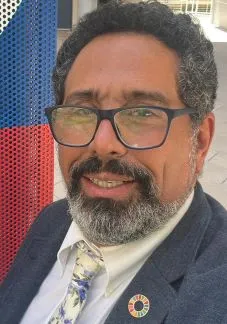
Yociel Marrero Báez has served as Director of the Environment and Consumption Program at the Antonio Núñez Jiménez Foundation for Nature and Humanity. Through this program, he developed strategies for socioeconomic alternatives that contribute to the sustainable development of Cuban society.
He completed his undergraduate studies in Moscow and later graduated as an environmental engineer in Havana. Marrero earned a master’s degree in Integrated Ecotechnology Management from Humboldt State University in California, United States. In 2008, in recognition of his work developing a system of environmental technologies to restore the Almendares-Vento watershed, he received the prestigious Architecture and Engineering Award from the Cuban College of Engineers.
For more than a decade, Marrero worked at Havana’s Metropolitan Park as Director of Research and Development, leading the environmental restoration program for the Almendares River watershed, the most important watershed in the Cuban capital. In addition, he has advised environmental projects in the Dominican Republic, Colombia, Argentina, and Brazil and has delivered lectures and taught courses at the University of California, Davis and Berkeley; North Carolina State University; Yale University’s MacMillan Center in New Haven; and the City University of New York (CUNY). He has also taught at the École des Ponts in Paris, the University of São Paulo in Brazil, the University of Santa Fe in Argentina, and the Technological University of Pereira in Colombia.
Marrero has organized numerous concerts and curated several art exhibitions to promote the protection of natural resources. These initiatives have become recognized forums for open dialogue among different groups and institutions, fostering greater harmony among the processes shaping Cuba’s socioeconomic development. He actively advocates for new economic models and sustainable consumption standards.
See also in Cuban Horizon:
The new environmental law in Cuba: Challenges and opportunities for foreign investment
Seeking alternatives to darkness: The need to promote bioelectric power in Cuba
An Examination of Cuba’s Non-Sugar Agricultural Sector (1959–1990)
Thoughts about Cuba’s Agricultural Development