
Women and Inequality in Work and Employment in Cuba
Women, who are overrepresented among university graduates in Cuba, still lag far behind men in average wages, labor-force participation, and employment in the private sector, whether as employees or business owners.
To Yadira AlBet, an extraordinary Cuban woman, although we never had the opportunity to meet in person...
Cuban social policy has traditionally aimed for egalitarianism. While laudable, this principle has the disadvantage of failing to take into account differences among demographic groups when distributing and allocating resources. Opportunity is understood as an end in itself rather than as a means of building an equitable society rather than a merely egalitarian one.
At the same time, the Cuban government has sought to maintain full employment, in principle and in fact, in the national labor landscape, even during the most critical years of the Special Period.[1] This commitment to full employment also produced unintended consequences, one of which was the growth of underemployment or hidden unemployment.[2]
The purpose of this article is not to provide a longitudinal analysis of women’s participation in the Cuban labor market, but rather to offer a snapshot of current conditions based on the most recent data published by the Cuban National Office of Statistics and Information (by its acronym in Spanish, “ONEI”) in 2022, 2023, and 2024. The goal is to provide a preliminary description of how gender inequalities are manifested in Cuba’s labor market today.
Women, Decision-Making, and Public Policy in Cuba
In Cuba, it has long been maintained that women’s integration into society constitutes a fundamental element for the country’s development. Women formally enjoy legal rights for which many of their counterparts around the world are still fighting.
However, integration is not inclusion, and inclusion does not guarantee representation. Women comprise 57.4% of the Cuban legislature. Although significant, this figure reveals only one dimension of women’s integration into society.
Although it is the only state institution vested with formal legislative and constitutional authority and empowered to enact laws, parliament exercises limited real influence over decision-making (Bahamonde, 2024a). It meets only twice a year. During the remainder of the year, it delegates its legislative functions to the Council of State.
Of the twenty-one members of the Council of State, eleven are women. However, there are two other power structures that are essential to decision-making in Cuba, and women are not proportionately represented in either of them.
The Political Bureau of the Communist Party of Cuba (by its acronym in Spanish, “PCC”) includes only three women among its thirteen members, while the Council of Ministers—the only bureaucratic structure of the Cuban government endowed with both legislative and executive powers—includes only five women among its thirty-two members. In addition, only one of the country’s five First Vice Ministers is a woman.
These data concerning women’s inclusion in effective decision-making are significant. As a result, public policy design has, in some respects, overlooked the differing needs of women and men that arise from complex social relationships and gender dynamics and that have become entrenched and normalized. These dynamics place responsibilities upon women that men rarely assume, such as caregiving and domestic work.
During periods of crisis, women’s vulnerability is magnified. In particular, the COVID-19 pandemic hindered women’s progress because the closure of schools, daycare centers, and other care facilities substantially increased the burden of their responsibilities.
Multiple factors influence women’s subordinate position in the contemporary Cuban labor market. The current crisis has intensified the cumulative effects of public policy decisions that have excluded women from access to capital accumulation.
Some of these decisions stem from the egalitarian principle that dominates public policy design and from the conception of opportunity as an end rather than a means. For example, from 1993 through 2021, the activities authorized for private sector self-employment consisted primarily of occupational categories in which men were represented at far higher rates than women, such as manual labor and service occupations.
Women have traditionally been concentrated in professional and technical occupations, which were excluded from the private sector for decades (Núñez Sarmiento, 2015, p. 117).[3] This policy, maintained for decades, further diminished their opportunities to accumulate capital and engage in private-sector activity, while reinforcing gender disparities
Women in the Post-COVID-19 World
The return of women to paid employment—or their continued participation in it—in the post-pandemic world has been slower and less successful than that of men. Women continue to be overrepresented in all vulnerable groups with respect to paid employment, and they were disproportionately affected by the crisis generated by the pandemic.
In 2022, women had lost employment at the rate of 5%, compared to a loss of 3.9% among men; estimated wage losses amounted to 8.1% for women, contrasted with 5.4% for men; and 53.4% of women reported spending more hours on unpaid caregiving activities, compared to only 20.9% of men (Women Returning to Work in a Post-Pandemic World: Busting the Myths of Flexibility and Choice, 2022).
Using information from the 2018 National Survey on Gender Equality (based on data collected in 2016), Maqueira and Torres (2021) demonstrated that Cuban women devote fourteen more hours per week than men to unpaid caregiving work (Center for Women’s Studies & Center for Population and Development Studies, 2018; Maqueira & Torres, 2021, p. 122).
Therefore, we may infer that both the pandemic and the ongoing economic crisis in Cuba have increased the number of hours Cuban women devote to such responsibilities, as occurred elsewhere in the world, at a substantial cost to their integration into the economy.
Women in the Current Cuban Context
The expansion of the Cuban crisis and its geographic and demographic distribution has not been uniform. Rural areas, the poorest provinces, and the most vulnerable groups—including older adults, non-White persons, women, and children—have been the most severely affected.
Some studies show that women and Black persons are disproportionately affected by poverty and inequality and are underrepresented in the more profitable emerging economic activities and sectors (Espina Prieto, 2015, p. 217).
Women’s participation in work and employment provides a fundamental lens through which to understand their level of inclusion in society.
Another determining factor, given women’s role in caregiving, is the deterioration and decline in both the quality and availability of care services in a context characterized by population aging and high levels of emigration, particularly among younger citizens (Albizu-Campos & Díaz-Briquets, 2023). This situation may place additional stress on women and limit their access to better-paying positions because they lack the time and conditions necessary to pursue such occupations.
It is also worth noting that the economic and social crisis compels women to devote not only more time but also a larger share of their income to caregiving responsibilities, further impoverishing them.
Women in the Cuban Labor Market
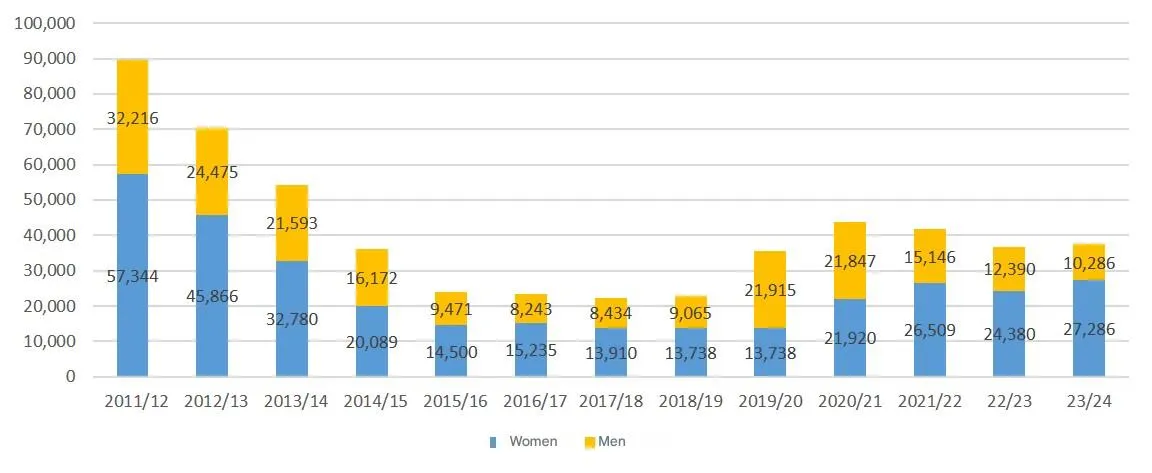
Women account for the largest share of university graduates in Cuba, representing more than 50% of all graduates and more than 60% in nearly every academic year since 2011–2012. Only in the 2019–2020 academic year did women account for just 38% of all graduates, coinciding with the year in which in-person instruction was suspended due to the COVID-19 pandemic.
It is reasonable to assume that a proportion of female students were required to devote more time to caregiving responsibilities during the pandemic, forcing them to postpone completion of their studies. The subsequent recovery in women’s graduation rates after the pandemic provides compelling evidence of this phenomenon.
The National Employment Survey published by ONEI in 2024 offers a snapshot of employment conditions during that year. Women account for only 38.3% of the employed population in Cuba. Even in the provinces with the highest levels of female employment, women do not make up half of the labor force: Santiago de Cuba (42.1%), Havana (41.3%), Guantánamo (40.9%), and Matanzas (40.2%) (Report of Results of the National Employment Survey—ENO 2024, 2025, Table 2).
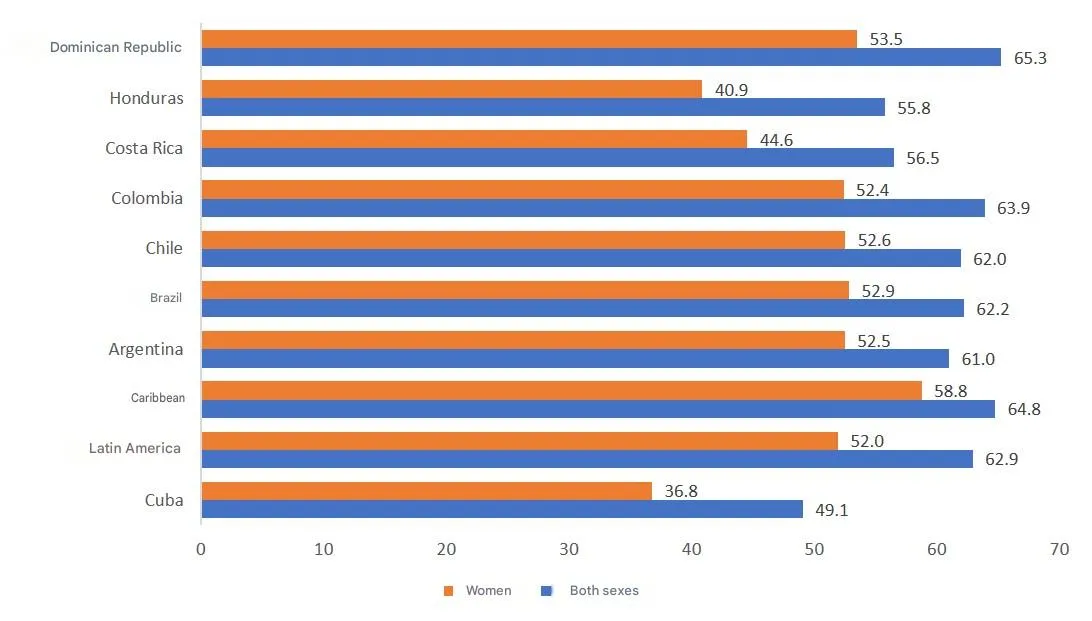
The female employment rate in Cuba stands at 36.8%, far below the male employment rate of 61.6% (Report of Results of the National Employment Survey—ENO 2024, 2025, Table 2).
According to the Economic Commission for Latin America and the Caribbean (ECLAC), the female employment rate in Latin America is 52%, while in the Caribbean it is 58.8%, both substantially higher than Cuba’s rate (Social Statistics—Statistical Yearbook for Latin America and the Caribbean 2025—CEPALSTAT Statistical Databases and Publications, n.d.).
Female employment in Cuba performs significantly below regional levels. Comparatively, it is troubling that Cuba, which has long portrayed itself as a champion of women’s integration into society, occupies such a disadvantaged position when it comes to women’s participation in paid employment, particularly given that women constitute the largest proportion of university graduates.
Figure 1. Overall and Female Employment Rates in Selected Countries of Latin America and the Caribbean (2024).
Source: Prepared by the author using data from ENO 2024 and Social Statistics—Statistical Yearbook for Latin America and the Caribbean 2025—CEPALSTAT Statistical Databases and Publications.
Women accounted for more than 60% of higher education graduates in the 2021–2022 and 2022–2023 academic years and represented 72% of all university graduates in Cuba in the 2023–2024 academic year. This is reflected in the high proportion of employed women working as professionals, scientists, and intellectuals - 34.1% of all employed women, compared to only 12.2% of employed men working in those occupations.
The distribution of employed men across occupational categories is more balanced than that of women, indicating the continued underrepresentation of women in certain technical and productive sectors traditionally dominated by men (Results Report of the National Employment Survey—ENO 2024, 2025, Table 5).
There is also a notable overrepresentation of men in the category of directors and managers (58.4%). This is particularly significant given that women constitute the majority of graduates in fields directly related to administration, such as economics and business disciplines, and represent 63.4% of professionals, scientists, and intellectuals (Report of Results of the National Employment Survey—ENO 2024, 2025, Table 6; ONEI, 2025, Tables 18.19 and 18.20).
Figure 2. Total University Graduates by Academic Year and Sex.
Source: Prepared by the author using ONEI data (2015, 2020, 2024).
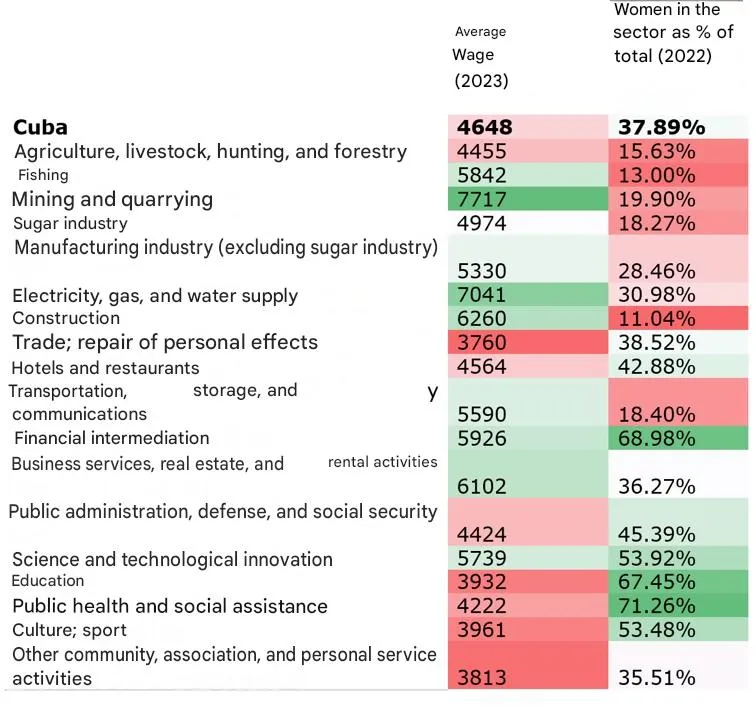
Women employed in the state and mixed sectors constitute a majority of those employed in numerous economic activities whose wages fall below the national average, such as education and public health, as can be seen, for example, in Table 1 below.
This underpaid employment in the state and mixed sectors, combined with women’s limited participation in the highest-paying activities within the private sector, provides insight into the disadvantaged position of women within Cuba’s income structure. Maqueira and Torres warned of the susceptibility of the return of Cuban women to paid employment after COVID-19, particularly in light of their predominant role in the health and scientific sectors and their fundamental role as caregivers (Maqueira & Torres, 2021, p. 121).
Table 1. Average Wage by Economic Activity in Cuban Pesos (2023) and Women’s Participation Rate in Employment by Economic Activity (2022)
Source: Prepared by the author using data from ONEI, 2024, 2025.
The Cuban state has gradually moved away from its position as the nearly exclusive employer it was during the 1980s and, by 2024, it employed approximately 68.5% of the country’s working population (Results Report of the National Employment Survey—ENO 2024, 2025, p. 20).
Since the crisis of the 1990s, Cuban professionals have faced the dilemma of either abandoning their professions and moving into the private or mixed-ownership sectors, or into tourism, in order to improve their standard of living, or remaining in state-controlled professions characterized by low levels of economic compensation.
Both choices involve costs and opportunities. The state sector has contracted significantly since the reforms launched under Raúl Castro beginning in 2010. The Cuban government has designed and implemented the expansion of the private sector as an acceptable employment solution or alternative in response to the contraction of the State as principal employer, rather than as a necessary complement contributing to economic and social growth and development of the nation. (Bahamonde, 2024b).
The current crisis has put this logic to the test. Gradually, the domestic private sector has gained ground not only as an employer but also as a provider of goods and services that the Cuban state is increasingly less capable of supplying.
From the perspective of labor relations, however, the private sector still has considerable room for improvement with respect to compliance with existing labor legislation and the protection of Cuban workers’ rights. Although this is not the central focus of this article, these shortcomings affect women’s participation in a segment of the economy that offers higher incomes than the state sector.
Women’s integration into the private sector faces numerous obstacles, ranging from discrimination to inflexibility in work conditions and violations of labor regulations concerning matters such as work schedules, paid vacations, and maternity leave. If properly respected and enforced, these protections would enable women to participate more actively in the private sector.
The numerical expression of this reality is striking. Women account for only 20.3% of partners in private or mixed micro, small, and medium-sized enterprises (MSMEs), only 31.4% of employees hired by such firms, only 20.6% of sole proprietorships without other employees, 24.5% of sole proprietorships with other employees, and 29% of employees of sole proprietorships (Report of Results of the National Employment Survey—ENO 2024, 2025, Table 10).
Ninety percent of informal employment in Cuba is concentrated in the non-state sector. As a general rule, women do not surpass men in their participation in informal employment. However, among the four provinces with the highest levels of informal employment—Havana (19.6%), Santiago de Cuba (10.1%), Holguín (8.9%), and Camagüey (8.7%)—the proportion of women engaged in informal work exceeds that of men in Havana (28.3%) and Santiago de Cuba (13.1%), and nearly equals it in Camagüey (8.8%) (Report of Results of the National Employment Survey—ENO 2024, 2025, Table 15).
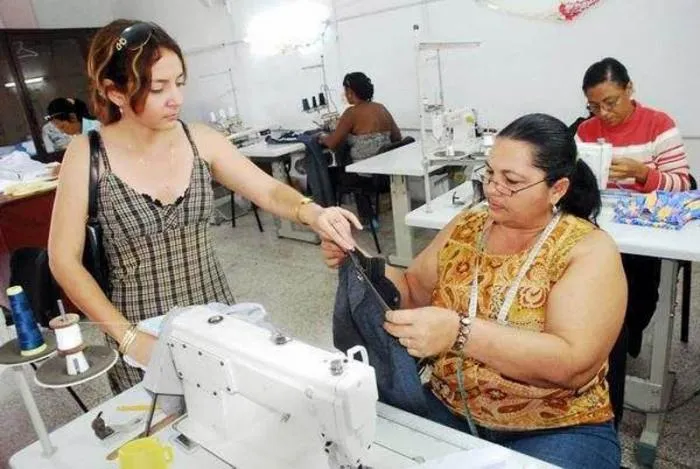
The Cuban population is concentrated in urban areas, so it is not surprising that most informal work is found in provinces with more densely populated cities. The greater participation of women in informal employment in urban areas may be related to persistent gender discrimination and to difficulties in gaining formal access to the private sector of the economy.
The disproportionate caregiving responsibilities assumed by women in Cuban households make them even more vulnerable to insecure but flexible forms of work, which are more common in the informal economy.
Although women account for 57.8% of those who devote time to subsistence production and 54.7% of those who devote time to volunteer work, the available data reveal no significant correlation between those variables[4] and participation in informal employment (Report of Results of the National Employment Survey—ENO 2024, 2025, Tables 15, 22, and 23).
For this reason, further research into the causes of the concentration of female informal employment in urban areas would be advisable.
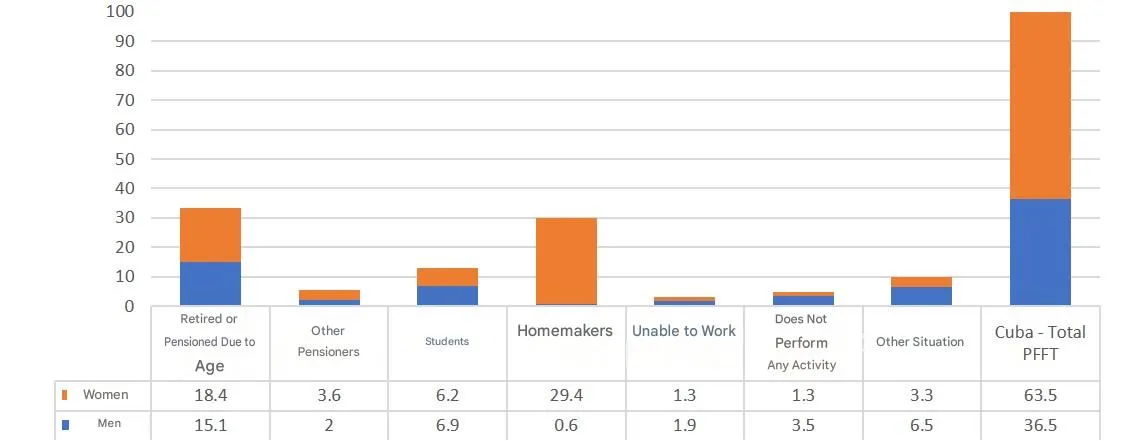
Although the female unemployment rate in Cuba is 2% (compared with 1.5% for men), the more troubling statistic is that, among the total population outside the labor force (aged 15 and over)—which accounts for 50% of the Economically Active Population—63.5% are women.
Among the 30% of persons outside the labor market (classified by ONEI as the Population Outside the Labor Force, or “PFFT”) who devote themselves to household duties, only 0.6% are men (Results Report of the National Employment Survey—ENO 2024, 2025, Table 21).
This imbalance demonstrates that the majority of women who are not engaged in paid employment are occupied with domestic and caregiving responsibilities.
Women are not overrepresented in any other category, including in the student category. They exceed men only slightly in one additional category—old-age pensioners—which can be explained by women’s higher life expectancy (80 years) compared with men’s (75 years) (ONEI, 2025, Table 3.17).
Figure 3. Population Outside the Labor Force (%).
Source: Prepared by the author on the basis of ENO (2024), Table 21.
Conclusions
Public policy design in Cuba does not have a woman’s face. Despite women’s high level of participation in the legislature, there is still a long way to go before genuine representation of women in decision-making is achieved. As Mala Htun has also demonstrated, inclusion does not guarantee representation, although it is a decisive step that brings us closer to it (Htun, 2016).
Women who participate in decision-making are constrained by several factors: political affiliation requirements; the persistence of a deeply patriarchal society in which a male perspective continues to dominate the interpretation of public policy problems and the formulation of proposed solutions; and the inevitable gender discrimination that accompanies such perspectives.
Women, despite being overrepresented among university graduates, continue to lag far behind men in average earnings, labor-force participation, and employment in the private sector, whether as employees or business owners. By contrast, they constitute the majority in lower-paying occupations and in unpaid work, such as household duties and the care of family members.
To reverse this situation, Cuba must rethink its social and economic policies, shift its focus from viewing opportunity as an end in itself to viewing opportunity as a means, and move from an emphasis on egalitarianism toward a commitment to equity.
In summary, public policies should focus on creating real conditions that enable Cuban women to gain effective—not merely formal—access to opportunities comparable to those available to their male counterparts.
References
Albizu-Campos, J. C., & Díaz-Briquets, S. (2023, January 26). Cuba and Emigration: Departure as a Voice. Horizonte Cubano – Cuba Capacity Building Project.
Bahamonde, T. L. (2024a). The Cuban State Decision-Making Process During Reforms (1990–2018) (Doctoral Dissertation, University of Delaware).
Bahamonde, T. L. (2024b, September 26). Incrementalism in Public Policy Design Regarding Cuba’s Domestic Private Sector. Horizonte Cubano – Cuba Capacity Building Project, Columbia Law School.
Center for Women’s Studies & Center for Population and Development Studies. (2018). National Survey on Gender Equality (ENIG-2016): Report of Results.
Espina Prieto, M. (2015). Economic Reform and Social Policy for Equity in Cuba. In M. Espina Prieto & D. Echevarría León (Eds.), Cuba: The Sociocultural Correlates of Economic Change (pp. 197–223). Ciencias Sociales & Ruth Casa Editorial.
Htun, M. (2016). Inclusion without Representation in Latin America: Gender Quotas and Ethnic Reservations. Cambridge University Press.
Report of Results of the National Employment Survey—ENO 2024. (2025). National Office of Statistics and Information of Cuba (ONEI).
Maqueira, A., & Torres, A. (2021). Cuba in the Time of COVID-19: Untangling Gendered Consequences. Agenda, 35(4), 117–128.
Mesa-Lago, C. (2010). Unemployment in Cuba: From Hidden to Visible. Espacio Laical, 4, 59–66.
Núñez Sarmiento, M. (2015). The Gendered Face of Havana’s Self-Employment Sector. In M. Espina Prieto & D. Echevarría León (Eds.), Cuba: The Sociocultural Correlates of Economic Change (pp. 113–127). Ciencias Sociales & Ruth Casa Editorial.
ONEI. (2024). 2023 Statistical Yearbook: Cuba. National Office of Statistics of Cuba (ONEI).
ONEI. (2025). 2024 Statistical Yearbook: Cuba. National Office of Statistics of Cuba (ONEI).
Social Statistics—Statistical Yearbook for Latin America and the Caribbean 2025—CEPALSTAT Statistical Databases and Publications. (n.d.). Retrieved May 8, 2026, from
Women Returning to Work in a Post-Pandemic World: Busting the Myths of Flexibility and Choice. (2022). Innovation Foundation.
[1] The period of the early 1990s, following the 1991 collapse of the Soviet Union.
[2] Carmelo Mesa-Lago estimated hidden unemployment at between 11.4% and 26.9% of the Economically Active Population (EAP). Mesa-Lago, 2010, p. 62.
[3] This policy, maintained over many years, further curtailed women’s opportunities to accumulate capital and participate in the private sector, thereby entrenching gender inequalities.
[4] The Pearson correlation coefficients were -0.09 and 0.23, respectively.