
Proposal to transform the cuban economy
This is the executive summary of a proposal by prominent Cuban economists to transform the Cuban economy.
1. Introduction
The Cuban model urgently needs comprehensive transformation: one that stabilizes the economy, restores its productive and institutional capacity, and builds a new development model capable of generating prosperity, equity, and opportunities for all Cubans. This is the premise that guides our proposal.
Our purpose is to use economic analysis to help identify the priorities, sequencing, and policy measures needed to halt the island’s economic and social decline, begin its recovery, and lay the foundations for a social market economy — one underpinned by a democratic state governed by the rule of law.
We recognize the inherent difficulties in such a process. The severe decapitalization of the Cuban economy, deteriorating public finances, the energy crisis, a weak financial system, and limited access to external financing all make substantial international support indispensable. This document therefore assumes a scenario in which Cuba regains access to international financing and moves toward normalizing its economic relations abroad, including a substantial easing of U.S. economic sanctions, which remain a major obstacle to recovery.
The proposals presented here treat economic transformation as a continuous, coherent process. It begins with macroeconomic stabilization and emergency measures to halt the economy's decline and protect the most vulnerable; proceeds to the recovery of productive and institutional capacity; and culminates in a consolidated medium- and long-term development strategy.
While this proposal was being drafted, the Cuban government announced a program of 176 economic measures. Our proposal is neither a response to that program nor an evaluation of it. Our recommendations follow their own methodology for prioritizing and sequencing policy, based on urgency, macroeconomic consistency, institutional feasibility, and the capacity to create the conditions a successful transformation requires.
This first proposal therefore focuses on the initial stabilization and emergency stage. That focus reflects the urgency of correcting the main macroeconomic imbalances, restoring the economy’s basic functions, and meeting the population's most pressing needs. These measures should not be read in isolation, however, but as the starting point of a broader transformation whose direction is set by the economic and institutional model developed in the sections that follow.
Within that stage, the energy crisis stands out as one of the highest priorities. More than a sectoral problem, it is today one of the main constraints on both economic recovery and the population's well-being.
This proposal aims to offer well-founded technical arguments that contribute to public debate and help build consensus on economic policy priorities in a possible process of change. It does not claim to provide definitive answers or to capture every existing approach; rather, it seeks to contribute to a plural, responsible discussion in search of viable solutions for the country.
The project has been developed by Cuban economists from diverse academic and professional backgrounds, with the institutional support of the Cuba Study Group and the Observatorio sobre la Economía Cubana (Observatory on the Cuban Economy).[1]
The proposal is organized as follows. Section 2 presents the economic and institutional model guiding the transformation; Section 3 develops a diagnosis of the country’s socio-economic condition; Section 4 sets out the political and international assumptions underlying the proposal; Sections 5 to 9 develop the principles, objectives, prioritization criteria, measures, and implementation sequence of the initial stage; and Section 10 offers final considerations. Two annexes conclude the document.
2. Vision for the Economic and Institutional Model and the Strategic Objective of the Transformation
This proposal recognizes the market’s decisive role in allocating resources and setting prices, but also the state's responsibility to guarantee a sound institutional framework, promote competition, correct market failures, provide public goods, protect the most vulnerable, and guide development through public policies that serve the general interest.
Economic transformation must be accompanied by political and institutional transformation, making it possible to build a social market economy underpinned by a democratic state governed by the rule of law.
A social market economy recognizes private enterprise as the main source of investment, innovation, and employment, without excluding public enterprise where that serves the general interest. At the same time, it requires a strong institutional framework guaranteeing competition, legal certainty, and compliance with market rules, along with public policies to distribute the benefits of growth more equitably and protect the collective interests of society.
A democratic state governed by the rule of law rests on, among other essential elements, freedom of expression, association, and the press; free, competitive, multiparty, inclusive, regular, and transparent elections; and the subordination of all public authority to the Constitution and the rule of law.
The transformation must be conceived, designed, led, and carried out by Cubans themselves, in keeping with the national interest. In this effort, the diaspora is an inseparable part of the nation and a strategic asset for the country's reconstruction. Its experience, professional skills, international networks, capital, and commitment to Cuba represent fundamental resources for accelerating economic recovery, modernizing production, and strengthening the country's integration into the global economy. Realizing that potential —while preserving national sovereignty and avoiding privileges incompatible with the general interest — will be key to a successful transformation process.
3. Diagnosis of the Current Situation
The crisis Cuba is experiencing is not cyclical and cannot be explained by recent external shocks alone. U.S. sanctions, the pandemic, the Venezuelan crisis, and the loss of external markets have sharply worsened the situation — but their impact has been so deep because they struck an economy already burdened by accumulated structural weaknesses, limited capacity to adjust, and long-postponed reforms.
From this perspective, the crisis reflects the convergence of interlocking structural factors. It therefore cannot be resolved through partial stabilization, more external financing, or the mere management of scarcity. It requires a comprehensive transformation of the economic and institutional model.
Much of the macroeconomic adjustment has already occurred, though in a disorderly, regressive, and socially costly way. In real terms, the state has lost the capacity to finance public goods, investment, social services, and subsidies, while inflation and currency depreciation have severely eroded the purchasing power of wages, pensions, and other peso-denominated income. As a result, domestic demand has contracted, and much of the cost of the crisis has shifted onto households.
The macroeconomic imbalances are therefore not solely a monetary or fiscal policy problem. They reflect structural weaknesses in production and in the institutional framework that governs how the economy works. Without a simultaneous transformation of productive capacity, economic incentives, and institutions, these imbalances will likely re-emerge even if some of their most visible symptoms are temporarily corrected.
The State's diminished capacity to guarantee a basic level of well-being has also driven a growing, de facto commodification of essential services. Poverty is thus ceasing to be a residual problem and becoming a structural feature of Cuban life, reflected in prolonged blackouts, deteriorating public transportation, and the growing presence of begging on the streets.
The international environment in which the Cuban economy operates has also changed profoundly. Old patterns of favorable external conditions based on intergovernmental agreements has gradually given way to a different kind of dependence — a growing gravitation toward the United States, organized not between governments but through millions of private and family ties.
The suspension of Venezuelan fuel shipments, the threatened tariffs on countries supplying oil to Cuba, and the sanctions on foreign entities linked to many Cuban companies — most of them tied to GAESA — sharply worsened the fuel shortage and forced several major foreign companies, many of them with long-standing ties to the island, to suspend their operations. All of this unfolded amid a broader reshaping of the international landscape, marked by the loss of government support in Latin America and limited material help from the Cuban government's geopolitical allies, Russia and China.
4. Assumptions About the National and International Political Context
This proposal rests on a set of assumptions about the national and international political context in which Cuba's economic transformation could begin.
First, that negotiations between Cuba and the United States achieve substantive progress. This assumption is essential because the current sanctions regime severely limits the Cuban economy's access to markets, financing, technology, investment, and normal international payment channels. A significant easing of sanctions would greatly amplify the benefits of the domestic transformation.
Second, that Cuba can reshape its international economic integration, breaking from the pattern of close dependence it experienced with the Soviet Union and Venezuela. The proposal seeks integration into international markets that diversifies Cuba’s partners and transactions and strengthens its economic autonomy.
Third, that emergency international financing is available. The first phase of stabilization and emergency measures cannot be financed solely with domestic resources alone, nor will easing sanctions alone be enough to cover the country's immediate needs. Without international financial support, a stabilization program would risk shifting an even greater share of the adjustment costs onto households, weakening the social legitimacy of the transformation.
Fourth, that domestic political conditions exist for launching the transition to a new model. Cuba's crisis is not only economic. It also reflects the exhaustion of an institutional arrangement that concentrates economic and political power, limits the autonomy of economic and social actors, and favors the persistence of partial, reversible, and insufficient reforms.
5. Phases and Guiding Principles of the Transformation
Phase 1. Stabilization and Emergency Transformation. With an expected horizon of roughly three years, this phase should aim to halt macroeconomic and social decline, correct the most critical imbalances and shortages, restore the minimum conditions for the economy to function, and build an initial foundation of confidence to facilitate later reforms. During this phase, energy, agriculture, and tourism will be the key sectors for reviving the production of goods and services.
Phase 2. Productive Recovery and Institutional Transformation. This phase should focus on the structural and institutional changes needed to allocate resource more efficiently, raise competitiveness, restore financial credibility, and sustain a gradual expansion of productive capacity, investment, employment, and household income.
Phase 3. Strategic Definition of the Economic and Social Development Model. This phase should aim to consolidate a medium- and long-term vision for Cuba's integration into the global economy, its strategic productive sectors, its mechanisms for redistributing wealth, the role of the state in the economy, and a new social contract.
The phases should be understood as a flexible roadmap, not as separate, self-contained compartments. Some measures begun in the first phase will create the conditions for reforms in later phases, while certain elements of the second phase should begin during the first to avoid delaying productive recovery and institutional transformation.
6. Overall Objectives of the First Phase
Over roughly three years, the stabilization and emergency transformation phase would aim to achieve the following:
- Halt the contraction in output and lay the groundwork for a gradual recovery of supply, especially in the sectors best able to drive recovery.
- Foster the growth of the private sector as an engine of recovery, job creation, and domestic supply.
- Realign relative prices and the exchange rate, so that prices better reflect market conditions and give clear signals for allocating resources efficiently.
- Transform the labor market, easing the reallocation of workers while keeping the average real wage stable.
- Create a minimum level of confidence and predictability to attract foreign capital and revive productive investment.
- Maximize the economic opportunities created by a possible easing of sanctions and greater integration into the global economy.
7. Criteria for Prioritizing Measures in the First Phase
The nine criteria used to select the first-phase measures are: severity of the problem being addressed; institutional capacity for implementation; feasibility of mobilizing the necessary financial resources; availability of infrastructure and physical capital; compatibility with demographic constraints and available workforce; multiplier effect on the rest of the economy; expected speed of implementation and results; effect on well-being and the social legitimacy of the reforms; and favorable international evidence and experience.
8. Specific Objectives and Measures for the First Phase.
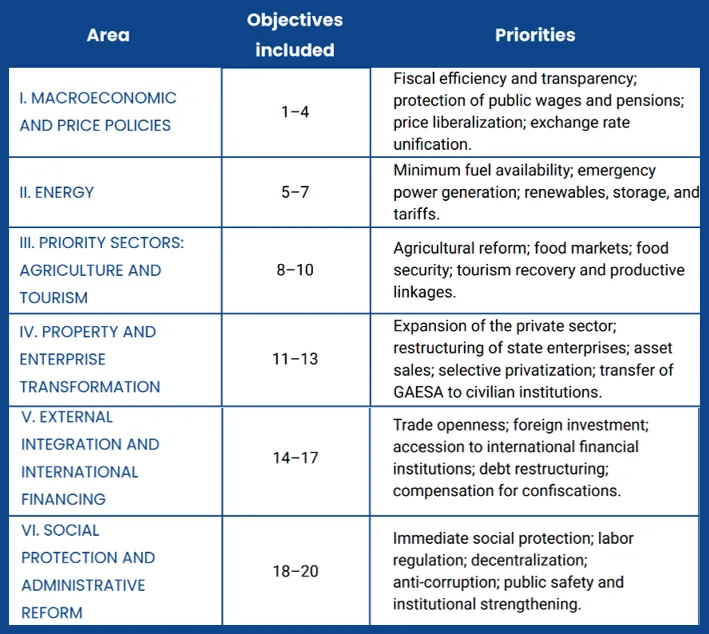
The first phase of stabilization and emergency transformation is organized around 20 specific objectives, each accompanied by a set of priority measures. These objectives should not be seen as isolated lines of action, but as interdependent parts of a whole. For clarity, the objectives and measures are grouped into six areas of intervention. This structure organizes the proposal around its principal areas of intervention, while recognizing that many measures require coordination across policy areas.
I. MACROECONOMIC AND PRICE POLICIES
1. Increase the efficiency of public spending and the transparency of public accounts
Priority measures
1.1. Integrate the operations of all state entities into the civilian fiscal framework.
1.2. Close, merge, or restructure unprofitable state enterprises once relative prices and the exchange rate have been corrected.
1.3. Reduce broad-based subsidies and continue moving toward subsidies better targeted at vulnerable households.
1.4. Strengthen the transparency of public accounts and establish a credible benchmark for price-setting and expectations.
2. Finance social protection and preserve the income of public-sector pensioners and salaried workers during the adjustment
Priority measures
2.1. Introduce targeted tax adjustments that favor formalization and employment.
2.2. Update public-sector pensions and wages based on inflation, the fiscal savings actually achieved, and additional resources.
2.3. Create a stabilization fund to channel proceeds from asset sales.
3. Liberalize prices, and establish transparent rules for prices that remain regulated
Priority measures
3.1. Liberalize prices in agricultural markets and eliminate any price cap or administrative price-fixing that distorts supply, except those tied to the state procurement quota in measure 9.1.
3.2. Extend more flexible, market-based price-setting to state enterprises.
3.3. Eliminate price caps on the private sector and define clearer, more predictable, and technically consistent mechanisms for regulating and updating the prices that remain regulated.
3.4. Raise interest rates and allow them to better reflect actual scarcity and inflation.
4. Unify exchange rates and the foreign exchange market
Priority measures
4.1. Bring official exchange rates closer to the more realistic reference rates that already exist in the economy.
4.2. Adopt a transitional managed-float exchange-rate regime.
4.3. Formalize informal foreign-exchange transactions.
II. ENERGY
5. Ensure the essential fuel supply
Priority measures
5.1. Establish temporary supply agreements with international suppliers to secure, during the first phase, a minimum volume of fuel for essential uses — power generation, basic transportation, aviation, and water supply.
5.2. Open the market for fuel imports, distribution, and sale, subject to appropriate regulation.
6. Reduce the electricity deficit, stabilize supply, and manage demand
Priority measures
6.1. Contract and deploy dispatchable emergency generation — floating power plants and other available technical solutions.
6.2. Rehabilitate existing facilities — conventional thermoelectric plants and distributed generation units.
6.3. Improve the quality of the fuel used in power generation.
6.4. Give large producers direct access to independent power generation.
6.5. Implement a program to reduce losses in transmission and distribution.
6.6. Gradually update tariffs for industrial, commercial, and public-sector consumers, with transitional rationing.
7. Expand renewable energy, especially solar (with storage), and adjust residential tariffs
Priority measures
7.1. Speed up the approval and execution of solar-plus-storage projects, both existing contracts and new ones.
7.2. Expand the self-consumption regime, allowing surplus power to be sold to the grid.
7.3. Apply new residential tariffs with a protected basic-consumption block.
III. PRIORITY SECTORS: AGRICULTURE AND TOURISM
8. Transform the rules governing ownership, tenure, and management of agricultural land
Priority measures
8.1. Allow private legal entities of any scale to operate in agriculture.
8.2. Extend usufruct contracts for idle state lands and establish a secondary market for usufruct certificates.
8.3. Establish a market for buying and selling agricultural land.
8.4. Gradually bring the state-owned land managed by the Basic Units of Cooperative Production (UBPC in Spanish) into the agricultural land market.
8.5. Adopt a hybrid model of agricultural financing.
9. Promote openness and competition in agricultural markets
Priority measures
9.1. Gradually eliminate the state procurement quota and replace mandatory contracts with voluntary contracts with the state at market prices.
9.2. Create physical regional wholesale markets in each province or producing area, operating by auction or free negotiation.
9.3. Authorize direct imports and exports by producers and traders, with temporary declining tariffs to protect domestic production.
9.4. Implement emergency measures to boost production in the short term.
9.5. Deploy digital trading infrastructure — e-commerce platforms, price information, and futures contracts — built on the wholesale markets in measure 9.2.
9.6. Create fiscal and tariff incentives for investment in agricultural infrastructure to raise the competitiveness of production.
10. Stimulate the recovery of international tourism
Priority measures
10.1. Reposition Cuba as a destination and diversify source markets.
10.2. Ensure a stable energy supply to the main tourist hubs and expand their capacity for renewable self-consumption.
10.3. Strengthen the links between tourism and domestic suppliers.
IV. PROPERTY AND ENTERPRISE TRANSFORMATION
11. Remove restrictions on the creation and growth of private enterprise
Priority measures
11.1. Eliminate the restrictions that limit private enterprise’s participation in the national economy.
11.2. Simplify and make more transparent the registration and establishment of private enterprises.
11.3. Establish a regulatory framework that supports micro, small and medium enterprises (MSMEs), with tax incentives.
12. Reorganize the state enterprise system: financial discipline, restructuring, orderly exit of nonviable enterprises, and the groundwork for privatization
Priority measures
12.1. Tighten the budget constraint on state enterprises.
12.2. Carry out an inventory and viability assessment of state enterprises.
12.3. Establish a legal insolvency framework and an orderly exit mechanism for nonviable enterprises.
12.4. Subject the remaining state-owned enterprises to sound corporate-governance standards.
12.5. Adopt the principles of privatization.
12.6. Establish the framework for privatization.
12.7. Define the criteria for determining where a state enterprise presence should be maintained.
13. Break up GAESA and transfer its enterprises, assets, and resources to civilian institutions
Priority measures
13.1. Break up GAESA's monopoly and transfer its enterprises and operations to open civilian structures subject to competition.
13.2. Integrate GAESA's resources into the state budget and develop a transparent process for the selective sale of assets.
13.3. Transfer to the Central Bank the international reserves and other foreign-currency holdings that GAESA currently retains.
V. EXTERNAL INTEGRATION AND INTERNATIONAL FINANCING
14. Promote external trade openness
Priority measures
14.1. Eliminate the foreign trade monopoly.
14.2. Eliminate import tariffs on capital goods, on intermediate goods not produced domestically, and on intermediate goods used in export-oriented production.
14.3. Simplify customs procedures and reduce non-tariff barriers to trade.
14.4. Promote exports by removing regulatory obstacles, easing access to international markets, and strengthening export capacity.
15. Facilitate foreign investment through regulatory, financial, productive, and labor-market openness, and by strengthening legal certainty
Priority measures
15.1. Simplify and make more transparent the registration and establishment of companies with foreign investment.
15.2. Simplify and differentiate approval procedures for foreign investment projects by scale and complexity.
15.3. Promote special economic zones and industrial parks with favorable conditions for investment and production.
15.4. Open foreign investment in non-bank financial institutions and develop a regulatory framework for offshore banking.
15.5. Establish transitional mechanisms for arbitration and the settlement of trade and investment disputes.
15.6. Ease hiring rules for foreign enterprises and investors.
16. Begin the process of reinserting Cuba into the international financial system
Priority measures
16.1. Submit formal applications for membership or readmission to the major international financial institutions.
16.2. Negotiate membership or readmission with those institutions.
16.3. Begin negotiations to restructure Cuba's external debt.
16.4. Restore the transparency and international comparability of economic and financial statistics.
17. Begin a comprehensive process of negotiating and resolving confiscation claims
Priority measures
17.1. Begin bilateral negotiations to resolve claims by foreign citizens and companies.
17.2. Establish the legal and institutional framework for registering, verifying, and resolving claims, both foreign and those of Cuban nationals.
17.3. Establish diversified, fiscally sustainable arrangements for restitution and compensation.
VI. SOCIAL PROTECTION AND ADMINISTRATIVE REFORM
18. Guarantee immediate social protection and develop proactive social policies for inclusive development
Priority measures
18.1. Implement a temporary protection and reintegration package for workers displaced by labor-market adjustment.
18.2. Create a national program to rehabilitate emergency services.
18.3. Invest in equity and productivity.
18.4. Incorporate mandatory social indicators into the monitoring and evaluation of the stabilization program.
19. Adapt the labor relations framework to economic transformation and guarantee fundamental labor rights
Priority measures
19.1. Temporarily ease fixed-term hiring rules for justified activities and circumstances.
19.2. Begin a comprehensive reform of the Labor Code to adapt it to an economy with diverse forms of ownership.
19.3. Adopt a new legal framework for labor relations that guarantees freedom of association and the right to strike.
20. Begin reforming public administration, strengthen transparency and anti-corruption efforts, and guarantee public safety
Priority measures
20.1. Approve a transitional framework for professionalizing the civil service.
20.2. Promote gradual decentralization with territorial and fiscal autonomy.
20.3. Adopt a transitional framework for transparency, public integrity, and anti-corruption.
20.4. Simplify and digitize priority administrative procedures.
20.5. Adopt a comprehensive strategy for public safety and protection against transnational threats.
9. Sequencing
The sequencing of the priority measures establishes the strategic and chronological order in which the macroeconomic, structural, and institutional actions would be implemented during the first phase of stabilization and emergency transformation.
It provides a roadmap designed to exploit the complementarities among the priority measures. Not all measures can be implemented simultaneously, and some depend on others being implemented first to produce the expected results.
The sequencing is illustrated in a Gantt chart covering three years, divided into six-months intervals (see Annex 2 in the full proposal).
10. Final Considerations
Macroeconomic stabilization and emergency measures are necessary for halting Cuba's economic and social decline, but their purpose is to create the economic, institutional, and political foundations for recovery and structural transformation. Halting that decline requires controlling inflation, balancing public finances, overhauling the monetary and exchange-rate system, reviving production, restoring basic services, overcoming the energy emergency, and protecting the most vulnerable.
Proactive social policy must be part of the transformation program from the outset, helping people adapt to new economic conditions. This would combine social and political viability with a strategy of inclusive development and a structural reduction of poverty.
The success of this first phase will depend on its ability to generate confidence, certainty, and the institutional capacity required to begin the transformation. It will require political leadership, technical capacity, discipline, transparency, and accountability, as well as broad-based national consensus to legitimize decisions and prevent the costs of transformation from falling disproportionately on the most vulnerable.
Alongside the national effort, Cuba needs broad support from the international community. Stabilization and the start of recovery require emergency financing, specialized technical assistance, stronger institutional capacity, and reintegration into the international financial system. Normalizing international economic relations, restructuring external debt, resolving pending claims, and removing the main obstacles that today limit Cuba's access to trade, investment, and external financing — in particular, economic sanctions — are essential to accelerating recovery and reducing the social costs of transformation.
The strategic horizon for this process is a social market economy within a democratic state governed by the rule of law. Expanding the role of markets and private initiative does not weaken the state; it redefines and strengthens its capacity.
The proposal presented here is not a closed program, nor does it offer definitive answers to all the challenges Cuba's transformation will face. Its design and implementation should be enriched through public debate, technical analysis, available evidence, and accumulated experience, and should be monitored continuously and adjusted as conditions evolve. It aims to contribute to a broader discussion of the alternatives and decisions the country faces, and it remains open to scrutiny, criticism, and proposals for improvement.
This article is a summary of a more comprehensive document that can be downloaded below.
[1] The conclusions and recommendations of this proposal reflect the authors’ technical and empirical analysis, together with their normative vision of the kind of society to which they aspire. Institutional support does not imply influence over or control over its content.