
Cuba’s Transition Toward an Open Access Fuels Distribution and Marketing System
For Cuba to have an open, independent and efficient fuel distribution and marketing business segment, it needs to restructure its current oil value chain monopolistic model.
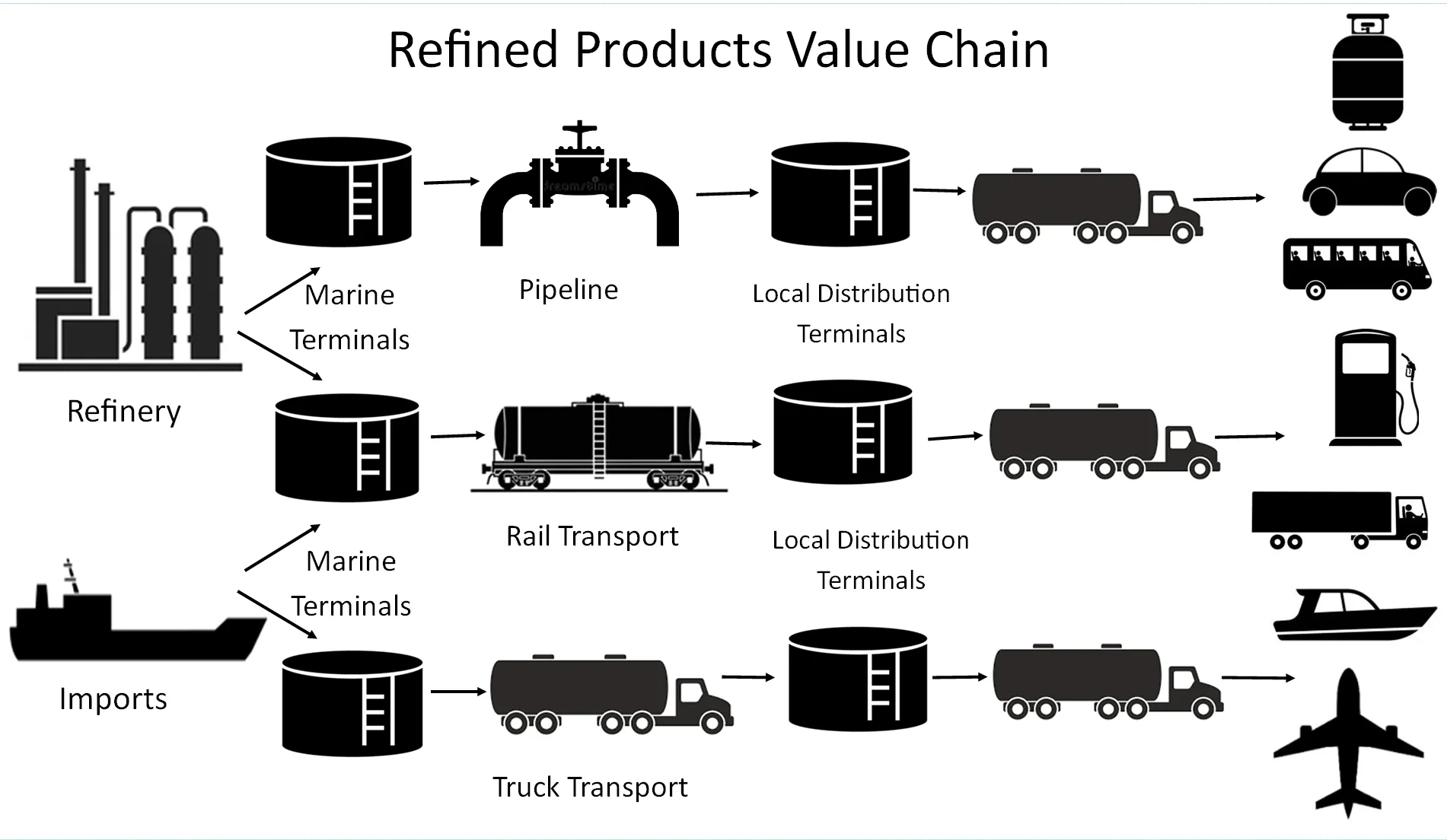
The distribution and marketing of fuels constitute the final link in the petroleum products value chain, following the refining of crude oil. This business segment is responsible for delivering fuel to the end customer.
Major oil companies such as ExxonMobil, Chevron, Shell, and others maintain divisions that encompass both the refining and the marketing of fuels. Nevertheless, this business sector also includes independent fuel distributors and marketers organized as small and medium enterprises (by their acronym in Spanish, “MIPYMES”) whose primary business is, precisely, the marketing of fuels.
These companies typically acquire fuels from refineries or from wholesale marketers, subsequently transporting, storing, and reselling them through wholesale channels or directly to consumers via service stations.
Some independent players focus on specific niches, for instance, supplying aviation fuel to airlines, marine fuels to shipping companies, or unbranded gasoline to independent service stations.
For this business sector to be successful, an open-access logistics system and a common carrier transport framework are indispensable.
In Cuba, the first step toward achieving this objective is the rationalization of the crude oil refining sector.
Cuba should phase out crude oil refining operations and convert the existing refinery sites into open-access common carrier petroleum terminals. This transition would modernize the country’s fuel supply system, reduce environmental impacts, and enable a competitive downstream fuels market within a decentralized economic model.
Current Structural Problems with Cuba’s Refineries
Cuba’s refineries suffer from severe technological and operational limitations that would require the investment of resources and time that the country currently does not have:
1. Most facilities were built more than six decades ago and have undergone little or no major capital investments.
2. The refineries lack modern conversion upgrading units such as catalytic cracking, coking, and hydrotreating.[i]
3. The refineries have a poor product yield structure; producing 54% high sulphur fuel oil with only 34% high value products such as diesel, jet-kerosene and gasoline.
4. They have limited crude slate flexibility because they lack complex upgrading units; Cuban refineries cannot efficiently process heavy, high-sulphur crude oils. This forces them to rely on more expensive light or medium crude grades such as: Mesa 30, Isthmus/Olmeca or Urals. This reduces operational flexibility and compresses margins.
5. The refineries significantly and negatively impact the environment, producing air pollution, ground contamination and water pollution.
Instead of investing billions in refinery modernization, while confronting numerous competing priorities, Cuba could repurpose existing refinery sites into petroleum product import, storage, and distribution terminals. These facilities would operate as an open-access common carrier infrastructure, allowing multiple fuel suppliers to import and distribute products across the country.
A useful precedent is found in Puerto Rico, where all refineries were closed between 1992 and 2009. The former refinery sites were converted into petroleum fuels storage and distribution terminals, allowing the island to rely on imported refined products rather than local refining. This model reduced environmental risk, improved cost structures and simplified fuel logistics.
Current-Future Market Structure in Cuba
Today, the Cuban state oil company, operating under the names CUPET and CIMEX, owns and controls all petroleum logistics infrastructure, including pipelines, marine terminals, storage facilities, distribution terminals and gasoline convenience retailing sites.
Were it to adopt in the future a decentralized economic model, Cuba could implement an open-access petroleum logistics system, available to all distributors, based on common carrier principles. Examples of such systems include: Exolum in Spain and Colonial Pipeline in the United States.
Most common carriers operate under regulatory oversight and offer open transportation to the public, not just for their owner's products. They are required to serve all qualified shippers fairly, based on capacity, under contractual terms and conditions. They charge regulated fees (tariffs) for transport, often on a per-unit or per-barrel basis. Shippers can use the service as needed and generally only pay for the capacity used, without entering into long-term commitments.
Anti-monopolistic regulations could be adopted, for example, where individual, private, or corporate entities may directly or indirectly hold no more than 25% of the common carrier capital or voting rights and the sum of direct or indirect volume sales held by shareholders’ market share shall not exceed 45%, as in the Spanish model.
Most likely in a future decentralized economic model a common carrier fuel transportation system would be needed to allow various brands and suppliers to compete under equal footing.
Transitioning to a terminal-based import system would reduce the need for expensive refinery modernization, lower environmental risks, increase supply reliability and enable multiple competing fuel brands.
Cuba already possesses a national network of petroleum ports that could support this model: Mariel, La Habana, Matanzas, Nuevitas, Moa, Santiago de Cuba, Cienfuegos and Nueva Gerona. These locations, along with a dozen local distribution terminals currently owned and operated by CUPET could serve as the backbone of a national open-access fuel distribution system.
Converting refinery assets into common carrier petroleum terminals offers a more efficient and competitive pathway for the Island’s energy future by creating a marketplace in which large international oil and refining companies can operate with the support of an independent class of wholesalers and distributors.
[i] Catalytic cracking, coking, and hydrotreating are industrial processes carried out within oil refineries. Their function is to transform the heavier fractions of crude oil and improve fuel quality: cracking and coking processes break down large molecules to produce more gasoline and diesel, while hydrotreating removes impurities such as sulfur to yield cleaner fuels.

Jorge R. Piñon began his thirty-two-year career in the energy sector when he joined Shell Oil Company’s supply and transportation organization. He served as president of Amoco Oil de México and president of Amoco Oil Latin America, based in Mexico City. After the merger between Amoco and BP, Mr. Piñon was transferred to Madrid, Spain, to manage BP Europe’s western Mediterranean petroleum supply and logistics operations.
Prior to joining The University of Texas at Austin as Director of The Center for International Energy and Environmental Policy’s Latin America and Caribbean Energy and Environmental Program he conducted research and country energy risk assessments as a Visiting Energy Fellow at the University of Miami’s Center for Hemispheric Policy, Brookings Institution and Florida International University’s Latin American and Caribbean Center.
Today he is an Energy Fellow at The University of Texas at Austin’s Energy Institute where he focuses in developing and maintaining a network of regional stakeholders that would likely affect UT Austin’s faculty, researchers, staff and students Latin America and Caribbean research programs and initiatives.
Mr. Piñon has testified on regional energy issues before committees of the U.S. Senate and U.S. House of Representatives. He holds a degree in Economics and a certificate in Latin American Studies from the University of Florida, from where he received the Center for Latin American Studies 2019 Lifetime Achievement Alumni Award.