
The Cuban Monetary Market in 2026
There is still room to try to restore the functions of the Cuban peso. Recent regulatory liberalization measures create more favorable conditions for adjustments in prices and exchange rates to have a meaningful impact on economic decisions.
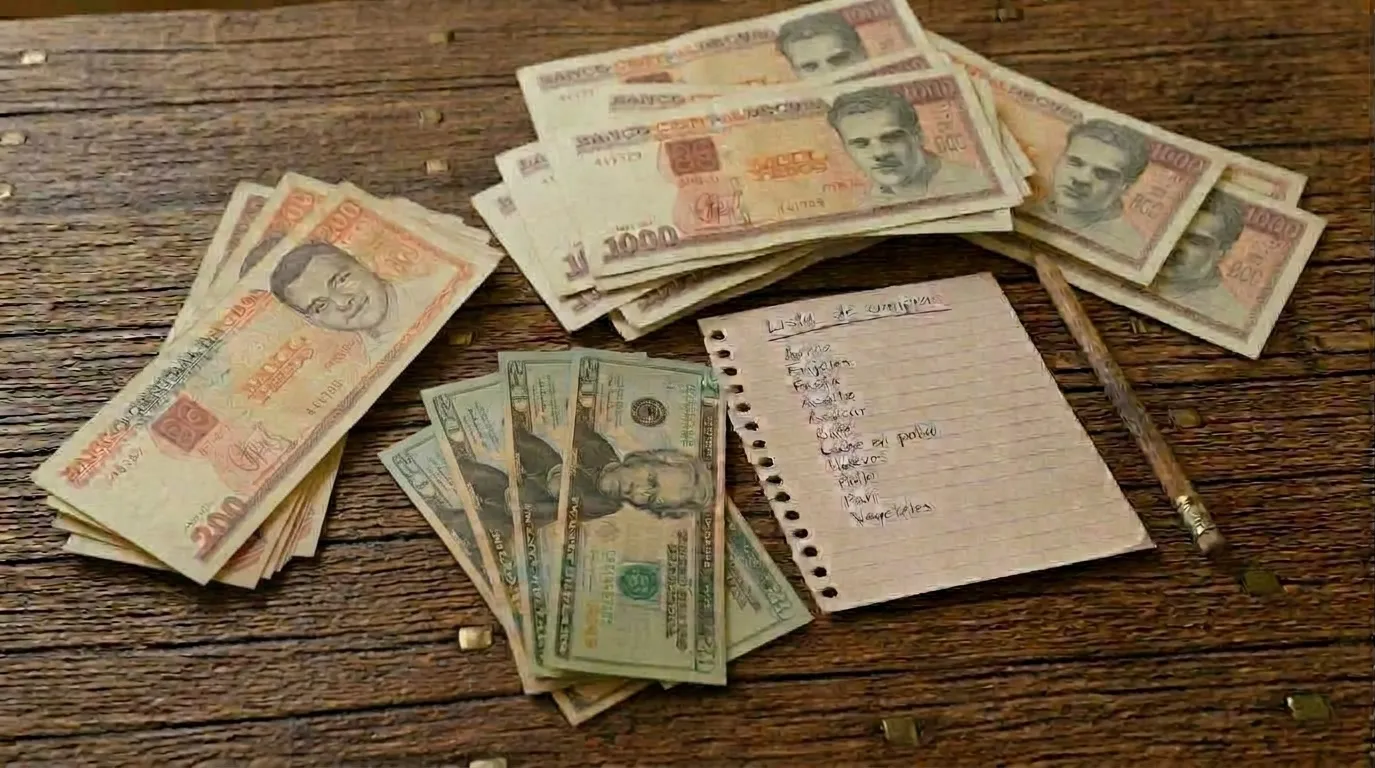
The expansion of U.S. sanctions, Cuba's domestic economic crisis, and disruptions in supplies and foreign trade have had a clear impact on the informal exchange rate and inflation in the Cuban economy in 2026.[1]
The Cuban government has introduced certain economic and financial liberalization measures, but severe fiscal and monetary imbalances, foreign currency shortages, and a lack of confidence in the banking system persist.
So far this year, the Cuban peso (CUP) has depreciated at a faster pace, dollarization has advanced, and disparities among exchange rates remain.
Informal Exchange Rates
During the first months of 2026, informal foreign exchange rates rose without the abrupt accelerations and exchange-rate stress experienced in previous periods. Lower demand for foreign currency among micro, small, and medium-sized enterprises (MSMEs) seeking to finance imports partly explained this relative moderation.
June was the most volatile month. The dollar approached 700 Cuban pesos, and the subsequent downward correction coincided with the announcement by the government of new market reforms and measures to liberalize the private sector. The increased willingness to sell foreign currency in the informal market, however, proved temporary. The dollar closed the month of June at 605 CUP, rebounded to 675 CUP by the end of July, and remained at that level through the end of August.
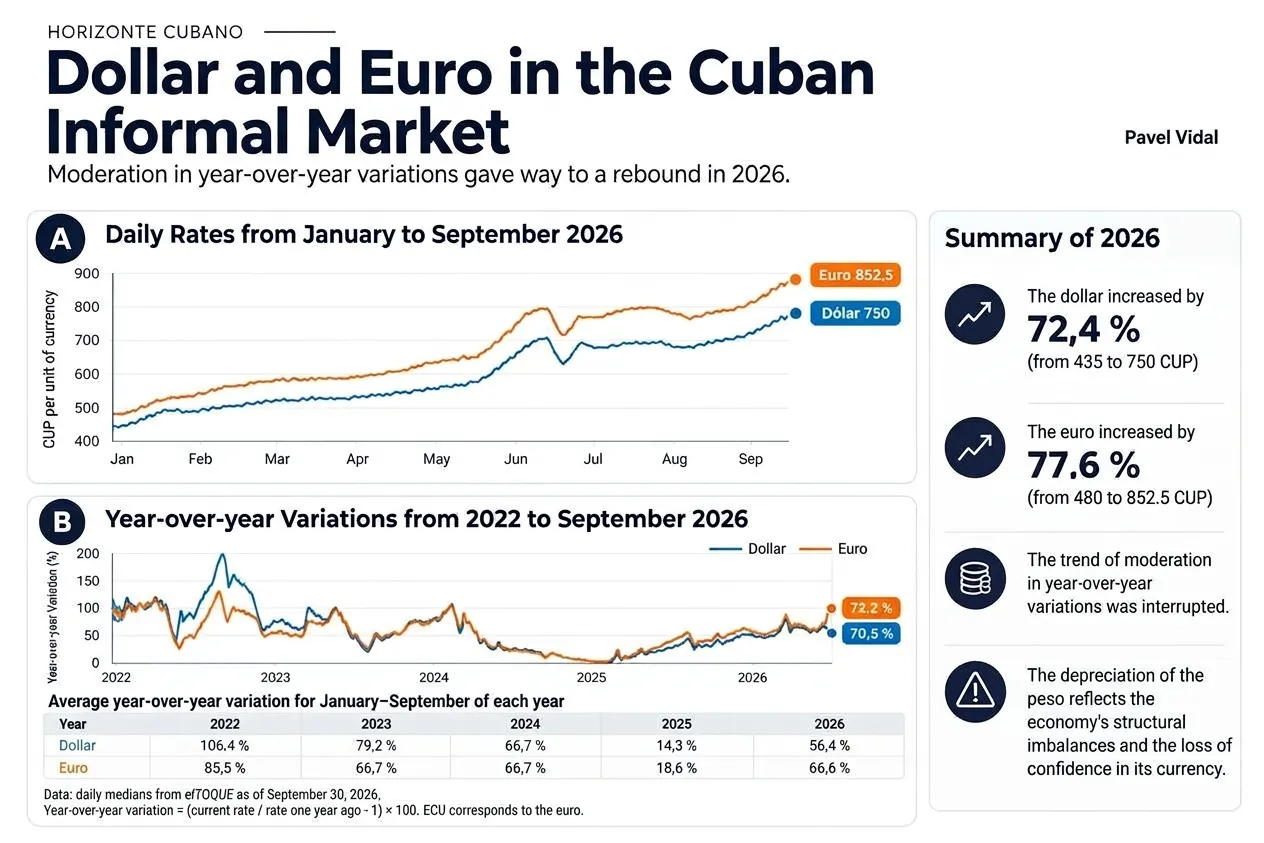
Since the second half of September, the amounts of dollars offered for purchase on the virtual platforms of the parallel foreign exchange market have increased steadily. The average daily amount rose from approximately US$47,700 during the first eleven days of the month to US$71,700 during the second half, an increase of nearly 50%.
This change coincides with the recent regulatory measures opening the economy further to the private sector, which may be driving greater demand for foreign currency. In an economy where domestic industry has virtually ground to a halt, the expansion of new projects and the replenishment of inventories depend heavily on imports of merchandise, supplies, and equipment.
According to the daily median exchange-rate series published by elTOQUE, between the end of 2025 and September 2026, the Dollar rose from 435 to 750 CUP, while the Euro increased from 480 to 852.5 CUP. Their exchange rates increased by 72.4% and 77.6%, respectively.
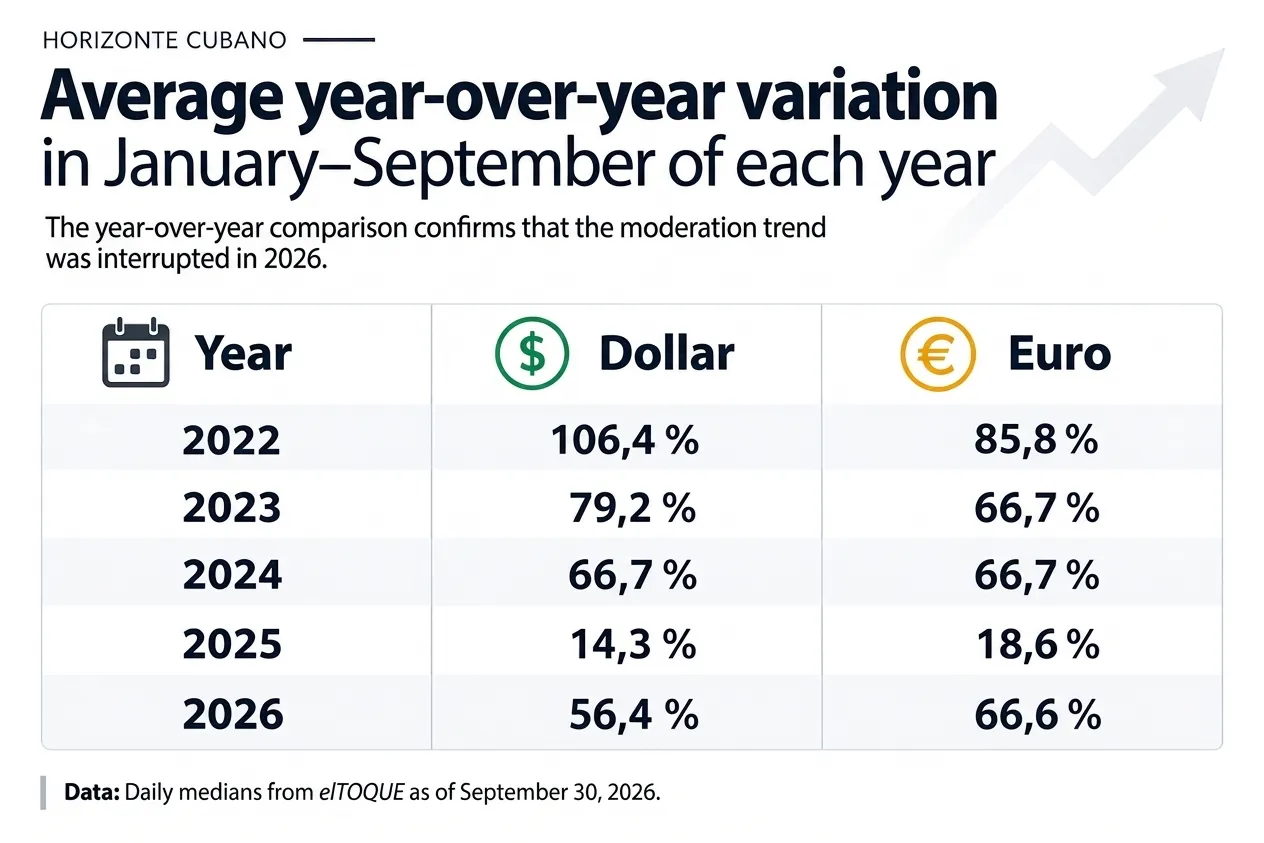
A year-over-year comparison confirms that the trend toward moderation has been interrupted. Between January and September, the Dollar's average year-over-year increase had declined from 106.4% in 2022 to 79.2% in 2023, 66.7% in 2024, and 14.3% in 2025. During the same months of 2026, it rose again to 56.4%. For the Euro, the corresponding increase rose from 18.6% in 2025 to 66.6% in 2026.
Resurgence of Inflation
Developments in the informal foreign exchange market confirm that the disinflationary process and the moderation of exchange-rate movements observed since 2023 have come to a halt.
The accelerating rise in foreign exchange rates feeds into the costs and prices consumers must pay for imported goods. The tightening of sanctions, declining sources of foreign currency earnings, supply constraints, and increasing uncertainty have continued to push up final prices in consumer markets.
Official inflation figures show this acceleration. The August data, published in September, recorded a monthly price increase of 4.92% and a year-over-year increase of 25.19%. Food and nonalcoholic beverages rose by 36.01% year over year. Outdated weights in the consumer price index limit the precision of these measurements. Even with these limitations, the renewed increase is consistent with worsening imbalances that fuel inflation: supply restrictions, higher energy and import costs, peso depreciation, and persistent fiscal and monetary problems.
Inflation has hit food and transportation particularly hard, further worsening living conditions and poverty. Cuba has already experienced a process of impoverishment through inflation and the decline in the real value of public spending and household incomes.
Advancing Dollarization
On September 10, the government relaxed the rules governing the opening and operation of foreign currency accounts and expanded the range of domestic and international transactions that account holders may conduct through them.
A fundamental change is that individuals and legal entities may now open these accounts without prior authorization from the Central Bank. For the private sector, the new regulations permit cash deposits, transfers, and the crediting of income generated by commercial transactions.
The new rules expand the dollarization of wholesale transactions between state-owned and private enterprises and, to a lesser extent, consumer markets. These measures represent another step in reversing the de-dollarization process initiated in 2004 and depart from the objective of the 2021 monetary reform, which sought to restore the CUP as the economy's sole currency.
Temporary partial dollarization may facilitate capital inflows and financing while confidence in banks and the credibility of the CUP recover. However, policymakers should prevent it from spreading excessively into consumer markets. Partial dollarization creates market segmentation and inequalities between those who have access to foreign currency and those who do not, particularly when full convertibility is absent and informal transactions and multiple exchange rates persist.
Complete dollarization would also entail relinquishing instruments for managing the money supply, interest rates, and lending to financial institutions, thereby increasing the economic and social costs of adjustment.
Is Financial Liberalization Beginning?
The Central Bank has announced a financial transformation that would allow new banks and institutions to operate with private and foreign capital, along with foreign exchange bureaus and financial technology companies. This liberalization could introduce competition, payment services, and new sources of financing.
However, it remains unclear how quickly these participants will enter the market, where they will obtain the capital needed to sustain their operations, and how much autonomy they will have in managing their resources.
The introduction of an official exchange rate under a managed floating regime on December 18, 2025, failed to shift a significant volume of transactions into the formal market. More frequent adjustments to the official reference rate have not resolved the CUP's convertibility problem. At the end of September, the official Segment III reference rate stood at 684 CUP per dollar, compared with 750 CUP in the informal market.
The opening of the first privately operated foreign exchange bureau, ADT 64, in Santa Clara represents an initial break with the state monopoly over formal currency exchange services. Its exchange rates were initially set above those prevailing in the informal market and subsequently fell below them. It remains unclear how the bureau determines its rates, how much autonomy it enjoys, what relationship it maintains with the Central Bank, or whether it can obtain CUPs from that institution.
The entry of additional independent, privately operated exchange bureaus competing with one another could encourage the development of a wholesale foreign exchange market. The potential benefits would be greater if CADECA, the government operated currency exchange houses, and the banks operated at rates close to those offered by private exchange bureaus and could trade foreign currency with them. In that case, an interdealer market would allow these institutions to complement their operations and offset liquidity imbalances.
Formalizing foreign exchange transactions helps curb dollarization. If individuals and businesses can buy and sell foreign currency through formal institutions at economically sound exchange rates, with foreign currency actually available, they have less need to replace the CUP with the Dollar in domestic transactions.
The CUP has experienced an extraordinary loss of value, but there is still room to attempt to restore its functions. Recent regulatory liberalization measures create more favorable conditions for price and exchange-rate adjustments to have a meaningful impact on economic decisions.
Their success will depend on restoring the national currency's stability, convertibility, and credibility, formalizing and expanding the foreign exchange market, and ensuring effective and transparent access to foreign currency purchases and sales. Without such measures, it will be extremely difficult to prevent further dollarization and the deepening of monetary segmentation and inequality.
[1] The sources for this work are the 2026 bulletins from the Observatory of Currency and Finances of Cuba (OMFI) published by the independent multimedia platform covering a wide variety of aspects of Cuba today elToque. (The link does not open directly. You must click it once and then click it again in the browser window that opens.)