
Beyond Polarization: The Overlooked Economic Bridge Between Cuba and the United States
Between 2021 and 2025, U.S. exports to Cuba increased by 148%, driven by the expansion of Cuba’s private sector, which demands inputs, equipment, and goods that domestic production cannot supply.
Despite political polarization, Havana and Miami have never been closer. While bilateral political conflict remains entrenched in decades of confrontation, a parallel reality has emerged in the economic sphere.
Cuba’s private sector and businesses in Miami, particularly those operated by Cuban Americans, are now deeply interconnected. This interconnection does not operate through formal bilateral agreements, but rather, through: remittances converted into capital; supply chains functioning in the small apertures of the two legal systems; talent that crosses the Florida Straits without leaving home; and digital platforms linking supply and demand across both sides of the Straits.
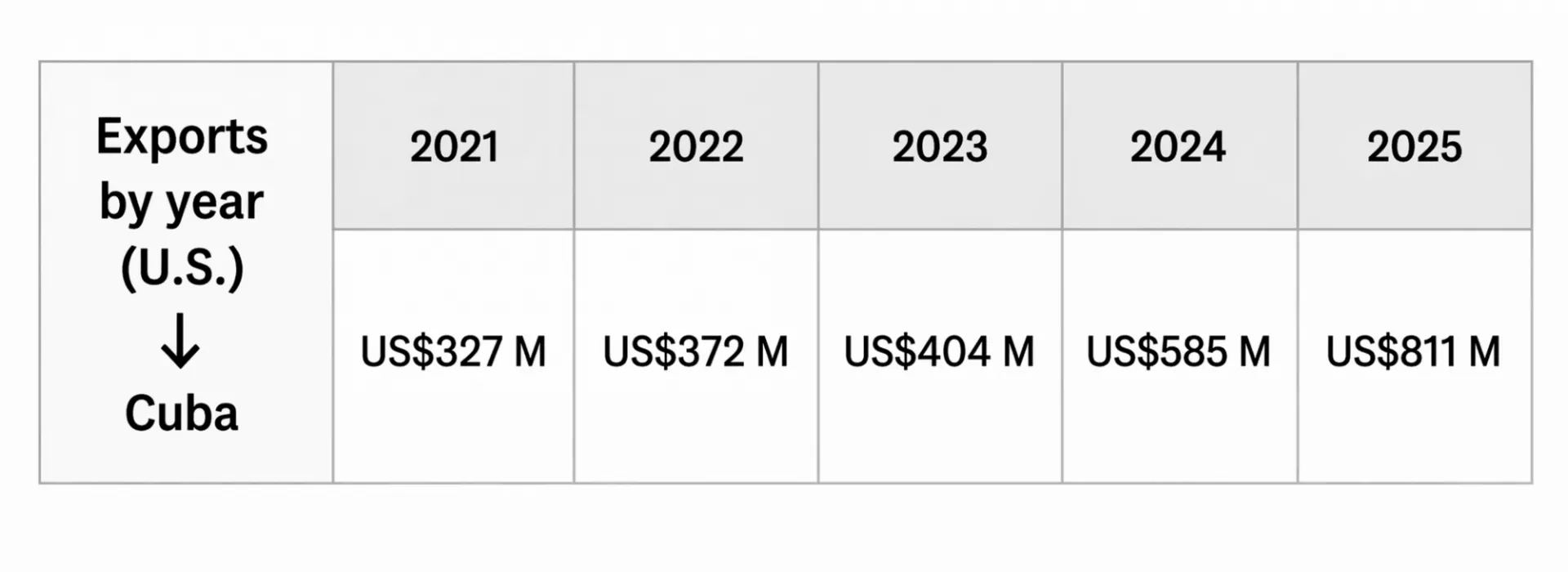
From 2021 to 2025, U.S. exports to Cuba rose from $327 million to $810.8 million. This growth was not incidental; it directly coincides with the expansion of the Cuban private sector, which requires inputs, equipment, and merchandise that domestic production cannot adequately provide.
In 2025, exports specifically directed to Cuba’s private small and medium enterprises (MSMEs) reached $173.6 million. Vehicles represented the most active export category, totaling $149.4 million—an increase of 122% compared to the previous year.
While U.S. exports to Cuba grew, Cuba’s total imports contracted sharply. Between 2022 and 2025, imports fell by 37%, affected by a foreign currency crisis and reduced trade with traditional partners such as Venezuela. In this period of overall contraction, the share of Cuba’s imports from the United States increased significantly, rising from 3.9% in 2021 to an estimated 13.1% in 2025.
Thus, while Cuba reduced its overall imports by 37% between 2021 and 2025, the U.S. share increased by 148%. Bilateral trade has functioned as a countercyclical channel, resilient to the impact of the foreign exchange crisis that has affected other suppliers.
The most plausible explanation is the “MSME effect.” Cuba’s private sector, largely financed by remittances from the United States, has generated demand for specific goods—vehicles, equipment, and inputs—that the Cuban state does not import in significant quantities. This has created a parallel import channel - independent of government foreign currency flows.
Remittances
Remittances from relatives and friends abroad constitute a critical source of fuel for the Cuban economy. They not only sustain household consumption but have become a major driver of private sector investment.
They function as seed capital for the creation of new MSMEs, as working capital for existing businesses, and as informal loans among family members and friends that support entrepreneurial activity.
Additionally, remittances bolster the purchasing power of residents on the island, who increasingly acquire basic goods through the private sector, whether through retail networks or online commerce platforms, creating a feedback loop that sustains the Cuban private business ecosystem.
A key actor in this ecosystem is the network of remittance and parcel service agencies operating in the U.S., primarily in Florida. Many of these firms, founded by Cuban Americans, have evolved significantly in recent years.
What began as simple money and package delivery services—often relying on informal couriers—has developed into complex logistics operations using air and maritime transport, delivering to Cuban households an increasingly diverse range of goods.
The most successful agencies now market products ranging from food to batteries, generators, motorcycles, and electric bicycles, responding rapidly to shifts in demand on the island.
Many have also established systems to facilitate purchases through platforms such as Amazon, Shein, and Temu, with guaranteed delivery to Cuba. These agencies often partner with local MSMEs, or create their own business entities on the island, in order to provide last-mile delivery, ensuring reliable distribution to end users.
The Epicenter
South Florida serves as the logistical epicenter of trade between the United States and Cuba. In 2023, Crowley Maritime, the only shipping company currently transporting goods from the United States to Cuba, reported that it was sending more than 300 containers per week to the Port of Mariel from Fort Lauderdale, North Carolina, and Jacksonville.
That same year, total U.S. exports to Cuba reached $404 million, a significant portion of which was destined for the Cuban private sector. Assuming an average container value of $30,000 to $50,000, these weekly shipments represent monthly flows of $3.6 to $6 million, and annual flows of $43 to $72 million through this shipping channel alone.
At the same time, digital labor flows have intensified. A software developer in Havana can work for a Miami-based startup without leaving Cuba; a Cuban graphic designer can create branding for a real estate firm in Orlando. These transactions occur via global platforms, with payments routed through third countries or intermediaries. Technology has effectively dematerialized the border.
To reach Cuban consumers, both on and off the island, Florida-based firms have deployed sophisticated digital marketing strategies. Social media platforms with high penetration among Cubans—Facebook, Instagram, and WhatsApp—have become the primary showcase for these businesses.
A detailed breakdown of U.S. exports to Cuba in 2025 reveals the composition of goods supplying the Cuban private sector.
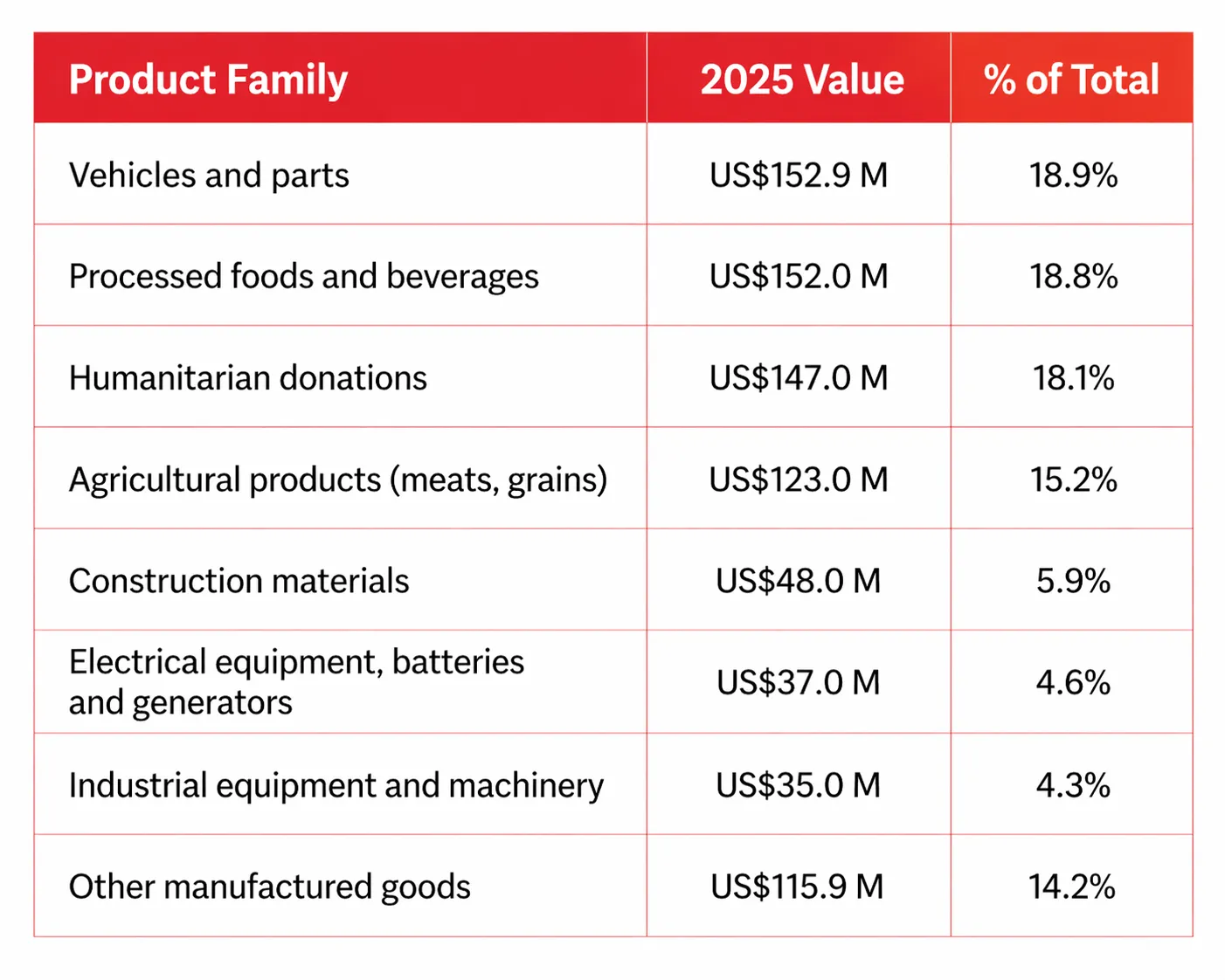
Agricultural products are dominated by chicken ($65 million) and pork ($45 million), accounting for 90% of that category, underscoring Cuba’s dependence on U.S. animal protein imports. Key suppliers include firms such as Pilgrim’s Pride and Koch Foods.
In the processed foods and beverages sector, brands such as Coca-Cola, Pepsi, Kellogg’s, Goya, Café La Llave, and Hershey’s maintain a strong presence in the Cuban market, supplying both retail networks and the private hospitality sector.
This article summarizes a broader academic study available for download here.
Beyond polarization the invisible economic bridge between Cuba and the United States.

Oniel Díaz Castellanos is a Cuban entrepreneur and consultant, recognized for his contribution to the development of the private sector in Cuba. He co-founded and is the general manager of the consulting firm AUGE, founded in 2014 in Havana, which specializes in business advisory services, including business strategy, business development, analysis of the economic environment, strategic communication, and support for small and medium-sized enterprises.
His professional trajectory includes positions of responsibility within Cuba’s state-owned business sector, such as Export Manager at LABIOFAM S.A. (2011–2015) and General Director of the Viral and Bacterial Vaccine Production Company within the LABIOFAM Business Group (2011). He also served as Managing Partner in Cuba for the international firm Kreab (2016–2020), a strategic consulting and corporate communications firm that operates in complex environments.
Mr. Díaz Castellanos holds a Bachelor’s degree in Biology from the University of Havana (1999–2004) and a Master’s degree in International Relations from the “Raúl Roa” Higher Institute of International Relations (2005–2010), as well as a diploma in Foreign Trade from the Cuban Institute of Foreign Trade (2012–2013).