
How Cuba Should be Thinking about Capturing Foreign Capital to Boost its Development
To attract capital, Cuba urgently needs an expansive view of sources of capital and a legal framework that fosters the influx while creating certainty for all economic players.

Introduction
Cuba needs capital now, and it needs a great deal of it. However, the State seems to both misunderstand what kind of capital it is likely to receive initially after opening its economy and how to capture it. It has not adopted modern corporate and commercial laws. Instead, it has focused on amending its foreign investment law. The new amendments were published in Decree 153/2026 on July 8, 2026; the foreign investment law, as amended is referred to as (the “Foreign Investment Law”).
The principal sources of capital that Cuba will be able to access in the early years after an economic transition will come from the Cuban diaspora. China and Vietnam have demonstrated that at first Western capital hesitated due to legal and political mistrust and it was their diasporas who were first willing to invest in the countries of their birth through their contacts in those countries. When China first opened its economy in 1978 (Gaige Kaifang) and Vietnam in 1986 (Đổi Mới), almost all of the initial investment came from their citizens then living abroad whose familial networks, linguistics ties and hometown connections made them more confident investors.[i]
In the case of Vietnam, early remittances evolved from a source of survival funds for families into seed capital for small, private family shops, restaurants, and farming enterprises. Recognizing this source of capital, Vietnam’s development policy has focused on the Vietnamese diaspora, which helped the country unleash its productive forces in their new free market.[ii]
Creating the Conditions for Large Capital Inflows
If Cuba seeks to obtain significant foreign direct investment quickly, it needs to create a legal regulatory framework that the foreign investors, including from the Cuban community abroad, can use to structure their investments. That means adopting modern corporate and commercial laws. It means, as well, independent courts in which foreigners and locals alike can resolve their disputes.
Adopting laws that are similar to the U.S. law would benefit the quick movement of capital from Cuba’s largest diaspora. This is because this is the legal system with which the U.S. based diaspora investors are familiar and which they will need to comply with (in addition to that of Cuba) when making an investment in Cuba. For example, having similar tax and accounting laws will facilitate tax compliance with the authorities in both countries.
Consider the U.S. the Delaware General Corporation Law as an example. (Delaware is the favored jurisdiction of incorporation in the U.S.). A corporation can be formed under Delaware law in 24 hours. Why? Because most of the provisions that would otherwise be needed to be included in a corporation’s founding documents are already provided by default in the Delaware law and do not need to be repeated in the certificate of incorporation.[iii] Specific provisions only if the founders wish some variation from the standard package found in the statute.
The corporate founders may select the name, a registered agent, the registered address, the purpose (usually chosen is “all lawful activities”), the names and the mailing addresses of the incorporators, and the classes of stock. The Delaware law’s default provisions provide the rules for the following, among others:
Subchapter IV. Directors and Officers
Subchapter V. Stock and Dividends
Subchapter VI. Stock Transfers
Subchapter VII. Meetings, Elections, Voting and Notice
Subchapter VIII. Amendment of Certificate of Incorporation; Changes in
Subchapter IX. Merger, Consolidation or Conversion
Subchapter X. Sale of Assets, Dissolution and Winding Up
Subchapter XI. Insolvency; Receivers and Trustees
The administrator in the State of Delaware reviewing the proposed corporate charter does not need to do more than check on whether the optional provisions have been complied with:
- the name is available (it has not been taken by another corporation),
- the classes of stock comply with what is permitted under the law, and
- the required names and addresses are provided.
As Delaware has made a fee-generating business out of incorporating businesses, it has a sliding fee schedule depending on how quickly the governmental review is requested. Delaware requires a local registered agent and identifying one takes 24-48 hours.[iv] The government review and the issuance of the certificate of incorporation can take from one hour to three weeks, depending on the fee paid and whether the application is made online or delivered in hard copy by U.S. mail.
Cuba’s Amendments to the Foreign Investment Law
The Foreign Investment Law appears designed to review large scale investment projects, such as mining operations. These types of projects may involve substantial investment capital, when viewed on a standalone basis, but are a drop in the bucket relative to all the capital investment needed by all sectors of the Cuban economy. Moreover, these transactions too will not be forthcoming absent the adoption of modern commercial and corporate laws. Also, deals involving large scale investment take more time and are more likely to occur if they are preceded by numerous smaller investments that are seen to be succeeding.
While the Foreign Investment Law now eliminates a few steps in the process required by its previous iteration, it is still far more unwieldy that it needs to be. This reflects that Cuba still considers itself a socialist command economy, with the State as owner, dealing in transactions with other socialist economies that are similarly structured. In the future, though, capital investments will be made not by other States but by individuals and companies from capitalist economies.
Three issues bear highlighting with the Foreign Investment Law:
First
The Foreign Investment Law seems to contemplate that the only investments to be made are those with substantial capital in major projects in sectors determined by government policy.
As discussed above, this does not address what is the likely coming reality: The initial capital inflows into Cuba, when Cuba creates the regulatory framework necessary to operate a market economy, will be generated from the Cuban diaspora and they will take the form of loans or contributions of capital to relatively small businesses, including agricultural businesses, created by friends and relatives in Cuba.
Since the Foreign Investment Law does not appear to distinguish by size or type of investment, applying it each and every loan or investment in the Cuban private sector would be a clunky procedure that could take many decades to generate adequate capital infusions to the Cuban economy.
It is possible that Cuba does not consider the capital contributions made through the remittances from family and friends abroad to Cuban businesses to be “investment capital? If so, this needs to be made clear.
Second
Cuba has adopted sectoral policies to identify areas of investment needed by the country. This concept is a residue of socialist centralized planning and does not address the dynamism of a market economy, where new opportunities are constantly presenting themselves that could not have been foreseen by those developing the sectoral policies.
Multinational investors seek to invest wherever they see the opportunity to profitably provide their products or services and to expand their own capabilities by acquiring existing businesses in order to obtain access to new technologies or local know-how. They do not begin their investment search by asking what sectoral policies the local government has and consider whether to invest in those. As a result, the business goals of the multinational will often not align with the governmental sectoral policies and strict application of the Foreign Investment Law will result in lost investments.
This would be unfortunate because each foreign investment made in Cuba, whether in the favored sectors or not, will likely produce benefits to the Cuban economy, creating new employment, depositing capital in local banks, training a workforce, providing access to intellectual capital, as well as throwing off new business ideas to be pursued by Cubans in Cuban-owned businesses.
Third
The focus of the Foreign Investment Law continues to contemplate approving each and every investment, requiring various levels of approvals and consecutive decision-making periods, instead of focusing review efforts by a small group of high-level officials on those investments that should require close governmental scrutiny – those that impact the security of the State and those that are to be made in a key industry.
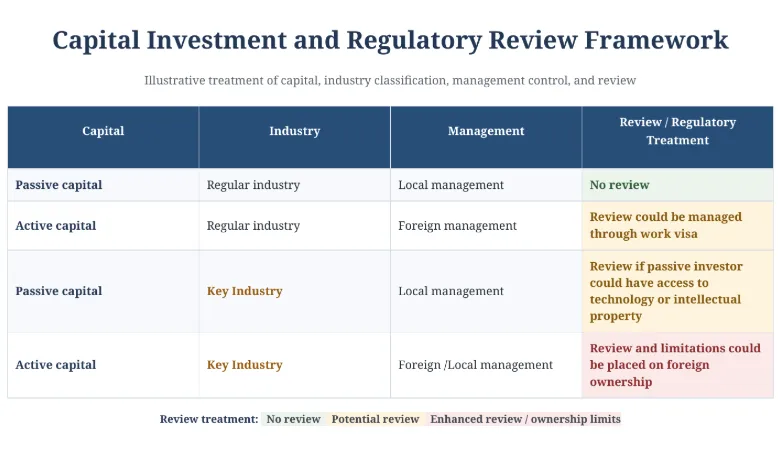
A distinction should be made between passive capital investments – those investments in Cuban entities that receive capital from abroad and are managed locally. Even if Cuba identified investments in construction as falling within its sectoral policies, why would it need to approve investments in commercial construction run by local Cubans? Is commercial construction an area of national security?
On the other hand, active capital investments that both (1) involve foreign controlling capital and (2) are managed in whole or in part by a representative of a foreign company, should be monitored if they fall in those areas of national security, such as defense, communications and public infrastructure and transportation. They should not be rejected out of hand if they fall in those areas, however, as Cuba will need capital to develop all areas of its economy.
Another distinction that the law should make is between key industries and those that do not provide Cuba a competitive edge. Biotechnology is Cuba’s foremost key industry and its intellectual property should be closely guarded. Even a passive capital investment in a key industry should require governmental review if the passive investor could likely obtain improper access to Cuban intellectual property.
The table below summarizes a proposed framework.
Comparison to the U.S. Approach
Let me very briefly describe the traditional approach taken by the U.S., which is the largest recipient of foreign direct investment in the world. This approach is attractive because (a) it does not require review of passive capital investments (except in strategic sectors); (b) it focuses on protecting national security and not protecting U.S. companies from foreign competition, and (c) it does not require consecutive levels of regulatory approvals: one committee of high-level government officials does the complete review.[v]
The Committee on Foreign Investment in the U.S. (CFIUS) has authority to review any:
1) Investment that results in control of a U.S. business by a foreign entity (25% of the equity or more) in a strategic sector or, for example, near a defense facility; and
2) Passive investment in any amount in any identified strategic sectors that allow the investor to get access to or information on strategic technology.
CFIUS is comprised of the leaders of key government departments, including treasury, commerce, defense, homeland security and national intelligence. The focus of the review is not to protect U.S. companies from competition but to protect against the direct or indirect control by a foreign government of U.S. companies that have been determined to be critical to U.S. national security[vi].
The review process is relatively short but could require the investor to make substantial changes to the proposed transaction.
Foreign companies and their local partners may file a short-form notice to CFIUS of the proposed transaction and the review process takes 30 days. If CFIUS does not require additional review, the parties may proceed with the transaction with reasonable certainty.
If CFIUS concludes the transaction needs additional review and may require changes in its structure, the committee requests that a longer-form approval process be initiated where the foreign investor will receive an answer within 45 days that: either it is free to move forward with the transaction or that it is required to submit additional information or make changes in the transaction, or both.
- CFIUS makes its recommendations to the President who has 15 days to make the final decision from receipt of the recommendation.
In addition to the open investment policies for most of the economy and the limitations on investments in strategic sectors, there are several areas of the economy that limit foreign ownership outright or foreign operations in the country and those are regulated by associated government ministries: Aviation; Maritime Transportation; Telecommunications; Energy; and Defense and Military Technology. For example, an airline with a foreign controlling shareholder cannot fly within U.S. airspace, it may only fly into or out of a specific U.S. destination.
Conclusion
Cuba’s reformed Foreign Investment Law falls short of what is needed to satisfy the nation’s development needs for two reasons: First, it continues to be an unwieldly old socialist world remnant with a focus on sectoral policies and levels of review that stretch out the approval process unnecessarily, instead of focusing on key industries and protecting national security. Second, even if corrected, it leaves the job half done: Cuba also needs to adopt modern commercial and corporate laws to realistically expect the needed influx of foreign capital.
The world is now one of market economies and the approach needs to be one that works in a market economy. Cuba could benefit from reviewing the foreign investment laws of, for example, Chile and Vietnam, which have been very successful.
Cuba’s need for capital requires it to focus urgently on how to facilitate its influx. So far, Cuba, it seems, continues to adopt laws designed to create work opportunities for government administrators instead of creating wealth through the private sector. In a market economy, that frame of mind has to change – the government regulates and the private sector creates wealth for the nation.
[i] Lee, John, “The Chinese Diaspora’s Role in the Rise of China”, East Asia Forum, September 15, 2016. See also, Andrew T. Pham, 2011. "The Returning Diaspora: Analyzing overseas Vietnamese (Viet Kieu) Contributions toward Vietnam’s Economic Growth," Working Papers 112, Development and Policies Research Center (DEPOCEN), Vietnam.
[ii] Pérez Villanueva, Omar Everleny, “The Diaspora in Vietnamese Development: Lessons for Cuba”, Horizonte Cubano, November 2, 2023.
[iii] See Delaware General Corporation Law. This is now also the case in all of the States, but Delaware has created a government industry in providing extra-rapid service.
[iv] A registered agent has to have an address in Delaware and is the principal contact for the corporation in Delaware.
[v] The Committee on Foreign Investment in the United States
[vi] The sectors identified are the following: Advanced technologies; Semiconductors; Microelectronics; Artificial intelligence; Quantum computing; Supercomputing; Critical infrastructure; Electricity generation; Transportation hubs; Telecommunications; and Sensitive data collection, including information on personal data of U.S. citizens.